Traffic Cardinal
wrote May 04, 2026
Traffic Cardinal
wrote May 04, 2026
Traffic Cardinal
wrote May 04, 2026
Traffic Cardinal
wrote May 04, 2026
Hi, my name’s Margarita and this is another Traffic Cardinal podcast—
Wait. I actually have something to share: as a podcast host, I’ve gained an immeasurable number of insights that deserve attention.
When I took voice acting classes, I did not pursue any particular goal: it was a decision made out of boredom, curiosity, pure tomfoolery—modern kids would’ve used a more apt term delulu—and admiration for a voice actor I’d been following on Instagram for ages. Never would I have thought that the techniques I learned at the studio with real actors playing on stage would actually be helpful in an extremely galvanic task that unexpectedly fell into my lap—hosting podcasts…
A Serendipitous Challenge
Now that I critically gauge the results of my work, I realize that I’m pretty good at it: I genuinely love people; I can wax eloquent when needed, and it’s always a pleasure to pry into the secrets of affiliate marketing and related niches. However, when I was first proposed to host podcasts, I was not so gung-ho: in point of fact, I deemed the entire endeavor to be one of the most haphazard things that have occurred to me, and, frankly, I would’ve been less bewildered—and horrified—if Leon S. Kennedy himself appeared at my door with a pack of flowers and a pistol in his holster. Am I exaggerating here? Yes, undoubtedly. Am I still flabbergasted? Also yes, and ready to resort to another word that I don’t normally use in my speech—bamboozled. The fact that it comes to me naturally does say something about the level of my astonishment.
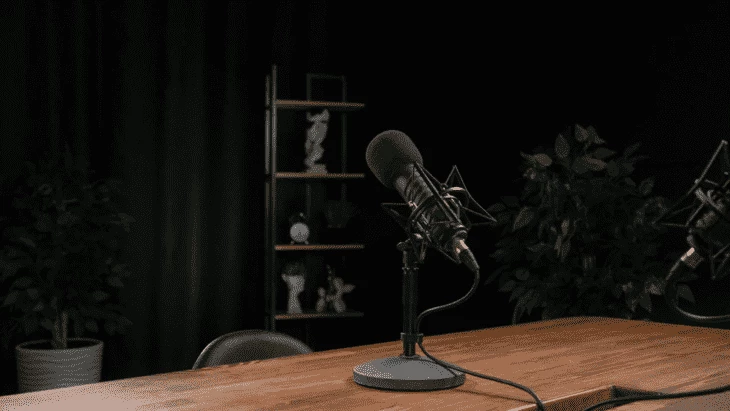
You see, English is not my native tongue. I was more than a little nervous to do an interview in it: I was afraid to stumble, make mistakes, or misunderstand the guest. My second concern was the process itself: although I was never camera-shy, the technicalities of filming presented me with a previously unknown degree of anxiety. Finally, the biggest problem was charisma: I didn’t know if I had enough of it to pull it off, and, essentially, create a friendly atmosphere for the guest to feel at ease. Surely I can come up with a litany of minor aspects that put me on edge, but this is not the right time—instead, I’ll just share the shortlist of things I latch onto to restore my mental stability, prepare for the podcast, and feel more or less confident while talking to prominent specialists I have never encountered in real life.
Digestible Stages
You retreat into the studio, recline into the chair, put on your headphones, tap the mic to check the sound, and call a top-drawer specialist to shoot the breeze and have a good laugh. At least this is the picture you see on the screen: sleek, vibrant, and, overall, up to snuff.
In reality, a podcast host goes through different stages of painstaking preparation. The components may shift depending on the situation, and, let’s be honest, I’m not a stickler for accuracy, but the general outline remains more or less the same. I recognize One-Week Preparation, One-Day Preparation, One-Hour Preparation, and One-Minute Preparation, with occasional notes throughout the process. I do not impose any of it on you, but you are more than welcome to get acquainted with these steps.
One Week Before the Podcast
A podcast host is not a registrar at a world-class university, but some duties do overlap, and, frankly, they can’t be sloughed off at a moment’s notice. Just like a secretary at a dean’s office, I juggle my phones, trying to keep track of all available dates and patiently discuss them with the studio, only to find out that the perfect day for the guest is the worst day for the cameramen: they’re fully booked, understaffed, or awaiting the Second Coming any time now. With an exasperated sigh, I propose rescheduling, and it turns out—predictably though—that the perfect day for the studio is not even remotely convenient for the speaker.
Repeat a few times, and nothing else in the world will be able to shatter your inner equanimity, trained by hours of negotiations between two parties who have never seen each other and won’t even communicate.
Jokes aside, (re)scheduling is probably one of the most grueling aspects of the podcast, even if you’re spearheading the initiative. You touch base with the studio and the guest, send proposals both ways, get rejected, and estimate whether you have enough time to turn things around should anything go south. One week is usually sufficient to pull any stunt and shift the date, so I wouldn’t insist on an earlier preparation, even though my overly diligent and a little ADHD-affected personality whispers that I should get it running two months before we roll.
With date and time confirmed, I can segue to stage two of Operation Podcast. I scroll through the guest’s socials, read their interviews, breeze through their achievements and plans, and check their pages on conference sources to see what topics they usually cover.
From the bulk of information I glean, I jot down the most useful bits I can strategically scatter across the conversation. These bits don’t have to be “scientifically” proven: the veracity of the findings can be corroborated or debunked later, which in itself creates a helpful hook, a foundation for a lively conversation. At the same time, it demonstrates the amount of effort you put into your work and roughly outlines the general pattern you will follow throughout the podcast. Besides, it’s a subtle ploy that lets you know the person you’re about to interview: from the content they post, you might deduce what approach fits them better—a jocular chat with a silly jest or a crisp and professional tone. Yes, the mere scraps of content will never give you the full picture, but major lapses may be avoided that early in production.
Next, you can proceed with the most interesting part of the process—questions. If you write them yourself, make a mental note to break the entire list into logical sections; if you delegate this task to a colleague, review the result and rearrange the points in a more appropriate fashion that corresponds with the previsualized outline. I, for one, tend to commence with a little warm-up: the first set of questions covers previous experiences, career path, skills that help in the current position, or hobbies. Such small details stoke interest, display genuine curiosity, and embolden your guest to share warm memories, anecdotes, or significant milestones that paved the path for future endeavors. Of course, you can’t just ogle at your journalistic handiwork—it should be sent to the speaker for endorsement before the podcast. As you can see, this is another time-sensitive aspect that should be taken care of well in advance; essentially, by starting preparation one week before the show, you solve potential organizational problems and avert potential disruptions.
One Day Before the Podcast
If the one-week-ago stage was organization, the one-day step centers on revision and rehearsal. As an extremely talkative and remarkably boisterous person by nature, I know my tendency to divagate and dovetail the details that were never on the list in the first place: if the guest briefly mentions Amazon, I might start yammering about Twitter; if they broach conferences, I’ll most likely recall my own experiences; if they share their views on AI, I’m close to going overboard with my own observations. It’s a natural flow of the conversation, and enthusiasm gushing from the host is arguably much better than a lackadaisical “okay, thank you so much”, but I need to be moderate—and, perhaps, predictable.
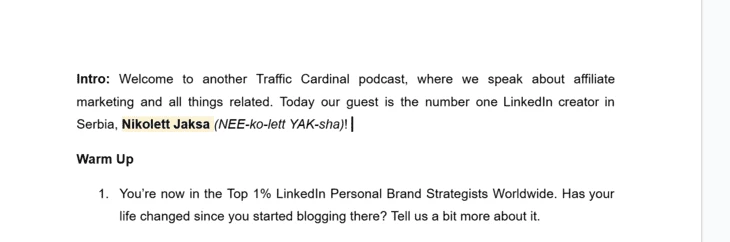
With that in mind, I open the questions document, previously endorsed by the speaker themself and revise it. Although I do not learn it by heart—only the intro and the outro aptly inserted shortly before approval—I try to memorize the general outline, question blocks, and intonation. In certain cases, I add succinct facts to the existing queries that can be later turned into hooks if the discussion peters out and needs to be revived. At the same time, I take notes: the structure of the question here is a little complex; the intonation pattern there should be clearer; that word should be enunciated; this sentence should be split in two for clarity, and, above all, I must ask the speaker how to pronounce their name, not to occasionally butcher it in the introduction. In all honesty, it looks much more difficult than it actually is: I have all the details on my hands, and I simply need to take a closer look at them before the powwow.
One Hour Before the Podcast
Without exaggeration, this is my favorite part! As I’m not the one who does the recording and checks the equipment, I can simply sit in front of the camera with the headphones on and do one of the most humbling things in existence: breathing/articulation warm-ups.
Before I elaborate on that, let me tell you this: sometimes I cheat. Unfortunately, you can hear it instantly—when I forget (or intentionally choose to forego) articulation exercises, my velvety voice morphs into a growl of an old sailor hunting for a bottle of rum. Thankfully, the voice acting teachers did not sugarcoat the situation and endowed me with the gift of knowledge: I learned to feel no shame while doing these visibly ridiculous exercises to deepen my voice, loosen up my jaw, warm up my vocal cords, and prepare my diaphragm.
I’ll spare the specifics (perhaps it will be a subject for my next article), but the main point is to “grease the cogs” before any sort of vocal performance. You can find a plethora of various breathing/articulation techniques on the internet and dabble with a few before creating your own checklist, but I can share mine, so you can envision what it looks like.
- The belly balloon. Sit or stand up straight, roll back your shoulders, and place your hand on your stomach. Take a long, deep, and slow inhale through your nose, expanding your belly. Then, exhale at the same pace, sucking your tummy in. Repeat a few times.
- Humming. Breathe deep with your stomach. Start humming as you exhale and place your hand onto your chest—if you feel vibration in your lungs and on your lips, you’re doing it right.
- Smile. Squeeze out a strained smile with pursed lips and then roll them into a “tube”. Then, slowly stretch the “tube” into another smile—this time, showing your teeth.
- Needle. Stretch your tongue as far as you can, as if you’re trying to reach a delicious dessert you’re not allowed to eat, and maintain this position for approximately five seconds. Then give the imaginable ice cream a generous lick, exaggeratedly rolling the tongue into the mouth cavity.
- Yawning. Somewhere in the middle of this embarrassing session, you’ll feel an irresistible urge to yawn: as I’m told, this is a natural reaction of the organism to an abundant supply of fresh air. It’s important not to resist the temptation and deliver a delicious, wide, and, above all, loud yawn!

One Minute Before the Podcast
Seasoned hosts—this is where it dawns upon me that I have every right to call myself one—may neglect the significance of the last minute before the call. As a rule, I’m not an advocate of omnipresent productivity streaking into every second of my existence; I’m literally the last person who would promote that sort of thing, but this is the only moment where I lock in, let the world diminish in scope, and summon my most professional self. Between you and me, I don’t even treat this last stage as a production process or troubleshooting; I simply see it as a perfect opportunity to ground myself in the situation, get myself together, and ensure that I am fully in control. Here’s my mic; the headphones are on my head and working; the cameras are ready to roll; the computer is quietly humming; the notes are clearly seen, and the podcast is about to start. I occasionally flip through the notes, refresh the intro/outro, get myself a glass of water, do one last articulation exercise, and repeat the most intricate questions or structures where I stumble.
During the Podcast
Initially, I was inclined to cut out this section altogether because the article seemed to be growing out of proportion and turning into an independent Podcast Bible with incessant “thou shalts” and “ought to’s”. Alas, I’m not a fan of rigorous protocol; I’m a creative rebel who wants to get it done without strict procedures, and dry delivery with zero ingenuity, in my opinion, kills the vibe.
Killing the vibe is possibly the worst you can do with your own content, especially if it aims to inspire people and ignite an inner flame in them, so I try to be a companion and a listener who’s genuinely interested in the subject. A podcast host cannot be a senseless dummy, tirelessly nodding their head: my job here is to express opinions, sum things up, clarify ideas, ask for clarification when necessary, and encourage guests to share their experience and views. Yes, I still make mistakes; no matter how much time I spend preparing for the show, the lack of tongue twisters before the interview takes its toll, and I have to muster my sense of humor and laugh it off. In other words, there’s no universal remedy that would guarantee a perfect podcast, but I might come up with a piece of advice that can certainly save the day: stay curious and don’t be afraid to slightly go off the script and ask to expand on the topic you do not fully understand.
Wrapping Up
Not many people are willing to admit that making a podcast is an art that is born at the crossroads of humanities, psychology, business, and storytelling: we are bound to seek a unique approach for each guest; we employ the skills of working with information; we discuss deals and business strategies, and we edit it to make the information accessible to other specialists across the globe. At the same time, it’s nigh-impossible to come up with the right formula to deliver an amalgamation of preparation and spontaneity, structure and instinct, discipline and play, so we constantly contrive new approaches and test them every time we schedule the interview: sometimes it’s necessary to ask one more question; in other cases, you can’t get off the script; then you stumble and laugh at your own mistake, and, essentially, you learn adapt to the situation and learn to remain engaged against all odds.
At its core, podcasting is a creative endeavor that is often shaped by the host’s personality, but before you feel confident enough to conduct a conversation, you need a guide that can explain the process and point out the main hurdles you may encounter along the way. I dare hope that I’ve done just that by equipping you with a sword and a shield to thwart the unexpected complications and inspiring you to go on.