Traffic Cardinal
wrote June 01, 2026
Traffic Cardinal
wrote June 01, 2026
Traffic Cardinal
wrote June 01, 2026
Traffic Cardinal
wrote June 01, 2026
The world is changing, the policies are shifting, and Facebook ad size is no longer what it used to be: even though the core characteristics remained the same, the company added new formats that can significantly improve your campaign or spark inspiration—yes, we firmly believe that inspiration is an integral part of affiliate marketing, you can’t change our mind. It was a remarkably long way to convey one simple idea: in this article, we intend to focus on Facebook ads, clarify the requirements, warn you about possible complications, and, in general, glean all the information to save you the trouble.
Facebook Ad Sizes Cheat Sheet (Quick Overview)
Facebook ad dimensions—this is one of the most common queries on Google, and we can’t emphasize its importance enough: this is the case where the naughty double entendre of the joke ‘size matters’ becomes a fundamental truth.
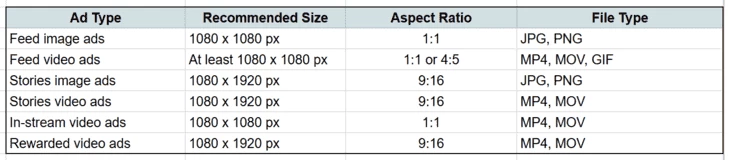
We will elaborate on each aspect in turn, but first, familiarize yourself with the general items of the most commonly used sizes:
Facebook Feed Ad Sizes
It only stands to reason that all size of Facebook ad discussions should be started with Facebook Feed ads, the most common and simple type—the ones that appear directly within users’ news feeds.
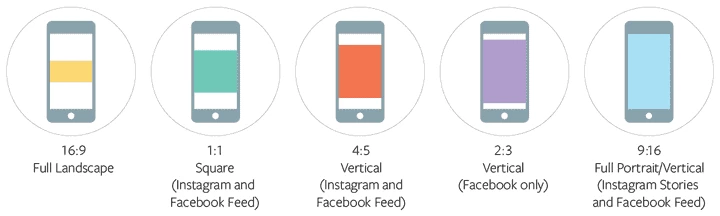
Size matters (source: video-production-switzerland)
Image ad sizes (Feed)
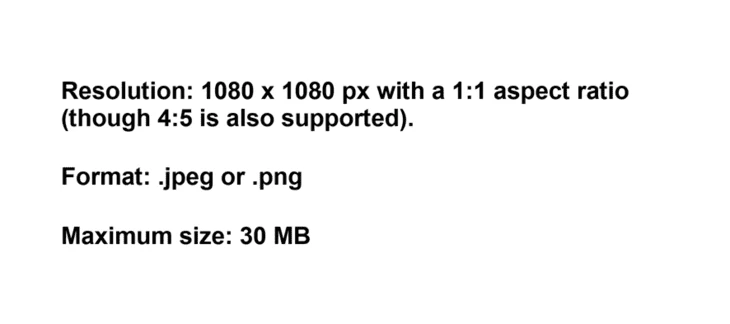
If you consider rushing into campaigns with image ads, scrutinize the details:
Video ad sizes (Feed)
Meta ads specs in video formats, however, do not remain the same, which is, frankly, understandable. Here we must point out that the video ads support square and vertical formats, and their resolution must not be lower than at least 1080 x 1080 px. Although vertical 4:5 videos aren’t an obvious choice, many affiliates prefer them to common 1:1 videos—they improve mobile visibility. Video formats are predictable: MOV, MP4, or GIF.
Character limits for feed ads
Facebook wouldn’t be Facebook if it hadn’t specified every single thing, and you know what we’re going to cover in the following sentences—text limits. Meta headline character limit states that you should not exceed 27 characters; primary text is recommended to be no longer than 125 characters, and description is best to contain only 27 characters.
It does not mean, however, that Facebook doesn’t allow longer copy—it does—but the point here is that concise messaging simply improves readability (which is of paramount importance considering modern attention span, the nadir of it).
Facebook Video Ad Specifications
In our conversation dedicated to meta ad sizes we’ve finally reached the point of video ads—another popular format among affiliates and another format that consistently enhances engagement.
Video feed ad specs
While video format may work everywhere, the general rule of thumb claims that they should be optimized for mobile viewing—we all scroll through videos on socials, right? Facebook’s no different. And, as you undoubtedly know, the best formats here are square (1:1) and vertical (4:5). The resolution, formats, and file size fully coincide with the data provided in the previous paragraph.
In-stream video ad sizes
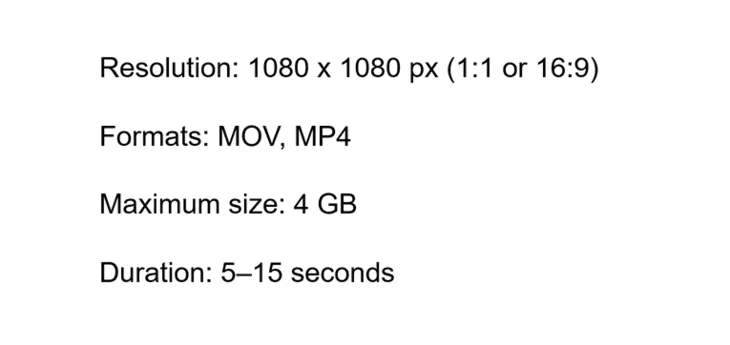
An article that tackles meta ads sizes must mention in-stream video ads, as they are designed specifically for video playback experiences and perform much better than you might expect. Such videos appear before, during, or after video content on Facebook, and often show best results with horizontal (16:9) or square (1:1) formats. Besides, this is where duration plays a significant part: the video performs best if its duration falls anywhere between a 5–15 second span.
Audience Network rewarded video specs
This is where things get interesting: audience network. If you regularly play games on your phone, you’re familiar with the subject matter—videos that provide incentives in exchange for watching an ad. In other words, you are offered a hint, a pack of gems, or a full solution after you watch the entire video.
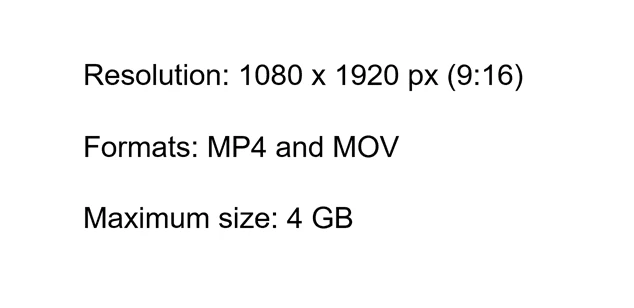
Although it visibly resembles all previous videos, the specifications, however, aren’t similar: resolution should be 1080 x 1920 px (with the aspect ratio of 9:16), and yes—it should be vertical.
Facebook Stories Ad Sizes
Stories are no longer exclusive to Instagram—the corporation expanded the format so much that now it exists on other products, for example, on Facebook. Hence, it would be unwise to ignore it in an explanation covering Meta ad dimensions.
Well, first of all, why do affiliates keep focusing on that? If you think it over, you might get your answer in a moment: the thing is that Facebook stories double down on mobile users, providing immersive and full-screen placements. All the specs dovetail with the nature of the format—and we’ll get to it shortly.
Image ad specs (Stories)
If you’ve even seen stories—in general, not this exact ad format—you can previsualize the information we’re going to deliver.
So, image specs: 1080 x 1920 px with an aspect ratio of 9:16. Formats: .jpeg or .png, which should not be displayed for longer than 5 seconds, and the maximum size must not exceed 30 MB.
Video ad specs (Stories)
If there’s anything affiliates should know about video Facebook stories, this is definitely their vertical orientation—they’re most convenient to watch on the phone (remember how you watch videos, and you’ll get it). While the resolution and ratio remain the same as in the previous option, the file formats differ (GIF, MP4, MOV), and the duration should also be taken into consideration. As stories are designed for fast consumption—and quick interaction, obviously—they should be short, but not too short. The recommended length in this case would be up to 2 minutes.

Character limits for Stories ads
When it comes to Facebook ad copy character limit, it must be clarified which sort of ad the affiliate is trying to implement into their strategy. Usually, we give precise numbers or at least specify the limits, but it’s harder to do with stories—the placement is typically more important than the actual number of symbols.
There’s only one clear rule: the copy should remain concise and “decluttered”, if that’s the apt description, besides you might want to use subtitles or captions to encourage more people to watch your ad—remember, not everyone watches them with sound.
Facebook Reels Ad Sizes
What is the best size for Facebook ads? To tell you the truth, it fully depends on the exact ad. We’re that deep in the article that we are ready to speak about Facebook reels—yes, they do exist, and they’re fairly popular among certain audiences, as they appear between organic Reels and support both full-screen video creatives and image overlays.
Reels image and video specs
Our improvised Facebook Reels guide wouldn’t be immaculate if we overlooked that both options are equally lucrative, though videos tend to dominate and enhance visibility, along with engagement. At the same time, the results may differ: in some niches, image creatives perform better than videos.
The image size should be 1440 x 2560 px with minimum dimensions of 600 x 600 px. Supported formats, as usual, .jpeg and .png, and the maximum size is also 30 MB.
With videos, the size remains the same (1440 x 2560 px with an aspect ratio of 9:16), but the formats will be MP4, GIF, or MOV. Surprisingly, there’s no particular length limit—perhaps you should double down on your analytical dashboard and adjust accordingly—but a compression requirement: H.264 with AAC audio.
Reels ad text limits
Finally, our favorite topic—Facebook ad copy length. Here we can give you some numbers: for primary text, remain within the 72-character limit; do not embellish the headline with complicated structures and keep it concise (10 characters at most), and make sure your CTA is also mobile-friendly and coherent. We can safely say that the texts are indeed important but not as vital as the visuals, so focus on the pictures instead.
Facebook Carousel Ad Sizes
Yes, Internet, I want to know the best size for Facebook ad, but this is a carousel ad—an interesting format that can contain both videos and photos at the same time. One of the most evident advantages here is that each carousel card can link to a separate landing page, which can boost the performance of storytelling campaigns, eCommerce brands, or different product showcases.
Carousel image specs
So, every picture in the carousel must be a part of a consistent pattern: 1080 x 1080 px or larger; 1:1 or 4:5; .jpeg or .png; max size not more than 30 MB. As for the number of cards, try a few approaches: the format allows you to smash together from 2 to 10 cards.
Carousel video specs
It’s even more interesting with videos. Perhaps it’s not too wise to make a carousel containing exclusively videos, but it could work perfectly if you mix static and motion creative within the same ad unit.
The size should be at least 1080 x 1080 px, aspect ratio is the same as before (1:1 or 4:5), the formats are the aforementioned MOV, GIF, or MP4, and the maximum size must not exceed 4 GB. By the way, long videos—up to 240 (!) minutes—are supported, but it doesn’t automatically mean that you should upload Nolan-esque movie endeavors. As a rule, shorter clips perform better.
Carousel ad text limits
One carousel encompasses several elements, and affiliates must be cautious not to turn their ad into a garish blur. Facebook ad headline character limit in this case would be up to 45 characters; the primary text should be about 80–125 characters, link description is up to 30 characters, and, finally, carousel card description should not exceed the benchmark of up to 18 characters per card.
Facebook Collection Ad Sizes
Carousels and collections are not the same thing, but you already know it if you’re in the business. Facebook Collections aim at mobile users and combine a cover image or video with product catalog elements underneath. As you can imagine, these ads are normally used within eCommerce campaigns.
Collection image specs
Of course, we speak about high-res images, nothing else would do: as the custom in eCommerce niches, the visual element plays a significant part. Nonetheless, we repeatedly return to one of the main aspects—facebook ad size in pixels—and here are the details you must know: size (at least 1080 x 1080 px with aspect ratio strictly 1:1); .jpeg or .png, and no bigger than 30 MB.
Collection video specs
Collections, however, don’t focus on images specifically—you can always opt for engaging videos, but the requirements will differ: the resolution and aspect ratio remain the same, but the formats considered are MP4, MOV, or GIF.
Collection ad requirements
Meta creative specs won’t cover character limit: there are more important factors at play. Among them, specialists often highlight the following:
Instant Experience is required
Collection ads are mobile-only placements
Product catalogs must be connected for catalog-based experiences
Ads can appear in Facebook Feed, Instagram Feed, and Stories placements
A cover image or cover video is required.
Additional Facebook Ad Placements
The options enumerated above are indeed rich, but if you think that the fountain of ad formats is about to run out, you’re mistaken: the facebook ads size topic persists, but so do we.
Right column ad sizes
First of all, there are right column ads, ads that appear on the desktop version of Facebook and are displayed alongside users’ feeds.
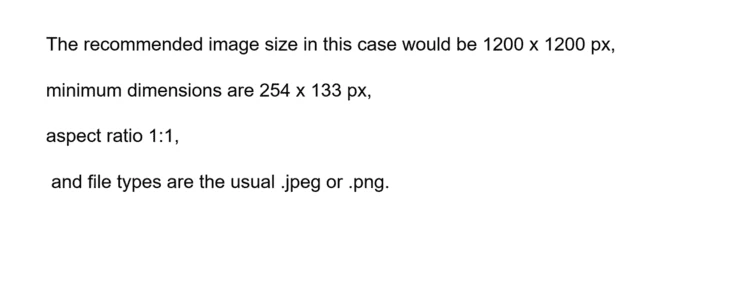
If you’re wondering about facebook ads headline character limit in terms of right column ads, well, it’s hard to come up with exact numbers: the space is already too limited, and you should opt for simple visuals and concise messaging.
Marketplace ad sizes
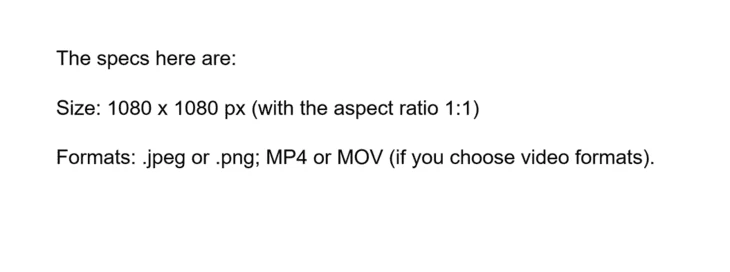
Then there’s Facebook Marketplace, and you’re probably aware of its existence. And yes, there’s also an ad opportunity, which naturally blends with organic product listings.
Search results ad specs
Are you in search? Maybe that’s your cue to try. Facebook Search Results, another valis option, includes ads that appear when user search for something on Facebook—products, content, or businesses.
As usual with facebook ad copy specs, you should focus on brevity as much as possible.
Business Explore ad specs
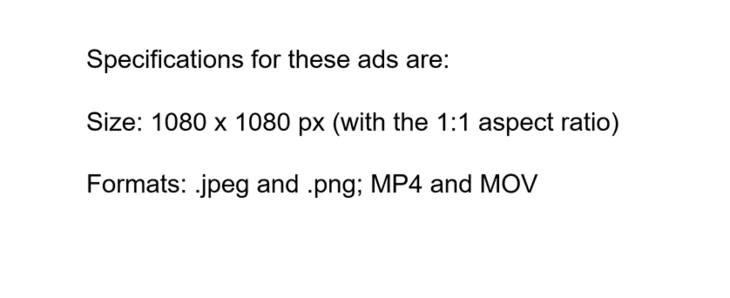
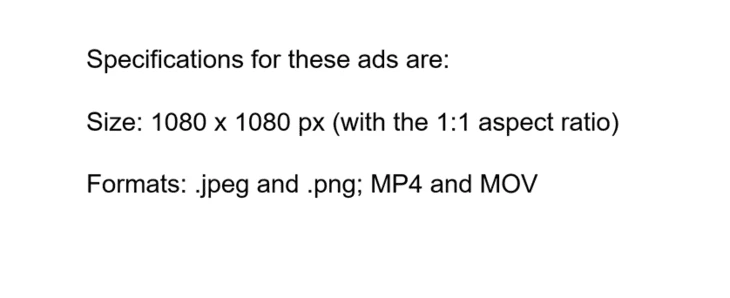
Another option that may come in handy is Business Explore placements, which emerge within Facebook’s business discovery environments, just where users browse services, products, and other business-related content. The image size remains the same as before, 1080 x 1080 px with the same aspect ratio of 1:1; formats are also unchanged (.jpeg and .png for images, and MP4 and MOV for videos). Keep in mind, however, that this ad format is largely mobile focused, so you should optimize accordingly.
Facebook & Instagram Cross-Platform Ad Specs
Unsurprisingly, Meta products are interconnected, and if you learn to work out the kinks, you can simultaneously run campaigns across two platforms at a time.
Universal Meta ad requirements
As both platforms belong to one corporation, their specifications overlap: both Facebook and Instagram ads feature .jpeg, .png, MOV, MP4, and GIF formats with 1080 x 1080 px resolution, and both platforms share the same views when it comes to text—no specific requirements have been mentioned, but it’s advised to keep the messaging to a minimum for better visibility.
Differences between Facebook and Instagram placements
Despite the resemblances, the two platforms are still different. Here are the main aspects you should keep in mind:
While feed placements on Facebook more commonly support square and horizontal formats, Instagram favors vertical formats with a more immersive slant.
Instagram is mobile-only, and all the campaigns must be adjusted with this exact idea in mind; Facebook, however, has desktop ads options, for example, Right Column ads.
Both Facebook and Instagram Stories and Reels, but on Instagram these ad formats rely almost exclusively on 9:16 vertical creatives.
Instagram, unlike its counterpart, generally emphasizes visual-first content with less on-screen text.
Advanced Facebook Ad Formats
More experienced affiliates might want to try their luck in advanced formats—the number of characters here may be not as important, but you’ll have to focus on other angles to improve interactive engagement or promote an app.
Instant Experience ad specs
Let’s start with Instant Experience ads, ads that are open into full-screen mobile landing experiences within Facebook and Instagram.
Playable ads requirements
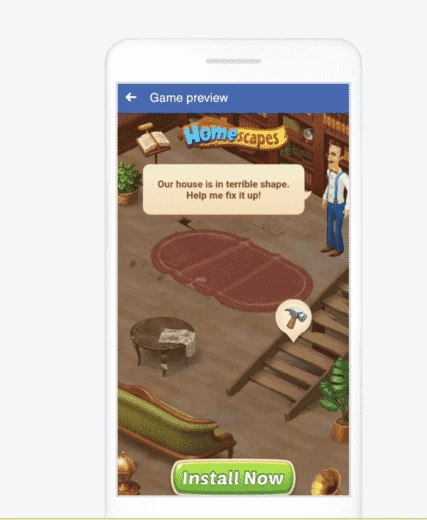
Playable ads is another interesting option that allows users to preview app functionality before downloading. The requirements center on the interactivity and demo experiences, as users want to test the game before installation. By the way, keep in mind that fast loading is crucial for engagement, so double down on it.
Slideshow ads specs
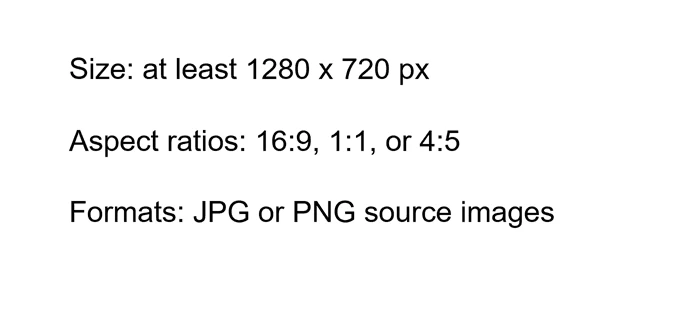
Lightweight animated sequences made from static images, yes, this is exactly what we mean by that title—consider them lower-bandwidth alternatives to video campaigns. To make your own successful sequence, focus on the requirements:
Audience Network formats (native, banner, interstitial)
As for Audience Network ads, these are the placements that extend Facebook advertising across third-party mobile apps and websites. It’s much more interesting because they don’t deal with resolutions/ratios/formats—they name exact types: natives, banners, interstitial, or rewarded videos.
Best Practices for Choosing Facebook Ad Sizes
A seemingly small thing—like resolution, for example—may eventually affect your metrics. Essentially, this is a make-me-or-break-me situation, so you should be careful to make sure you’re enhancing your engagement and performance across Meta placements.
Recommended formats for performance
At the same time, it’s possible to reveal a pattern and conclude which formats tend to perform across all Facebook placements. The majority of Meta traffic comes from mobile devices (which is not a secret, considering mobile devices’ growing share), so you should always optimize for mobile. Still, we can single out a few consistently performing options:

Common mistakes to avoid
One of the most common mistakes is low-resolution images. Some people think that users pay no heed to whatever’s happening on the screen if it happens fast enough, but no. In the world where people are incredibly fastidious, you should cater to their needs and whims, and, more often than not, the general whim remains the same: we want high-resolution pictures.
Then, affiliates may rely on text a little too much, peppering every single picture with lines of wisecracks no one’s going to read. While you may indeed be a talented writer and even more gifted seller, you should direct your writing endeavors someplace else because once your creatives drown in volumes of words, they are no longer interested.
There’s also a problem that might not be seen as something serious, but you will register the consequences once you make this blunder. Of course we’re speaking about horizontal placements shoved into vertical slots such as Facebook Stories and Reels. It usually leads to poor user experience and reduced engagement: Meta systems may cut off visuals elements crucial for the narrative; the texts may overlay, and CTAs can become absolutely unreadable.
Then there’s a creative that has not been adjusted. Idle affiliates tend to run their campaign across several placements with the same creative, but different platforms trigger different scrolling patterns, so one and the same creative will not perform with the same results: Stories are fast and visual; Right Columns are only for desktops; Reels require instant hooks, and feed ads may contain longer copy. Essentially, you should stick to your analytics dashboard in order to find out what works on the platforms you are targeting.
Tips for higher engagement
The tips we are going to mention are solely based on the findings we have unraveled in the text above.
- As vertical creatives pertain to most ads formats and are germane to many of them across all Meta products, you should stick to them and center your approach and creatives on how to use them.
- Facebook ads don’t usually rely on text, but text is nonetheless an important part of the ad. With that being said, try to keep all the texts concise and make sure that they are correctly displayed both on mobile and desktop.
- Not everyone watches videos with sound: some are doing it discreetly from their colleagues, others prefer to listen to music while scrolling the feed, and there’s a secret third thing—people who are only studying the language and accomplish their listening comprehension tasks while watching random things. If you add captions, you’ll appeal to three more groups of people, who might want to check out your product.
Conclusion: Choosing the Right Facebook Ad Format
Facebook is a source of ad formats and placements you can use in your campaign: regardless of the niche, you will always find something that suits your taste and business goals.
FAQ