Traffic Cardinal
wrote March 06, 2026
Traffic Cardinal
wrote March 06, 2026
Traffic Cardinal
wrote March 06, 2026
Traffic Cardinal
wrote March 06, 2026
Impulsive behaviour and staged urgency are the best friends of every sales funnel. Sure, if you make the path from pitch to conversion smooth, remove every possible stumble and then top it off with big promises and a countdown timer for good measure, the user is on the hook. Or… are they?
Turns out, not every audience plays along with that script. For some people, this whole approach is alien. And if the date on your calendar still hasn’t dropped a big enough hint, we’ll say it outright: today we are talking about women – the “measure twice, cut once” kind of crowd. Grab a pen and a notepad and get ready to jot down where and why female traffic leaks out of your funnels and what you can fix to patch those holes. Off we go!
Why Women Don’t Sprint to the CTA
Women aren’t inherently “hard to convert”, it’d be wrong to assume that. If female users keep slipping out of your funnel, our guess is it’s optimised for the wrong kind of brain.
Before you rage-quit this page and make it your personal mission to cancel us into oblivion, let us explain. We know how that sounds – like we are about to pull out a dusty “men are from Mars” chart. Not doing that.
But broadly, a lot of consumer-behaviour work points in the same direction: gender can nudge how people move toward a purchase. Women, more often than not, compare a bit harder, look for more info before they commit, lean more on other people’s experiences as a reality check and get more alert around risk when money’s involved.
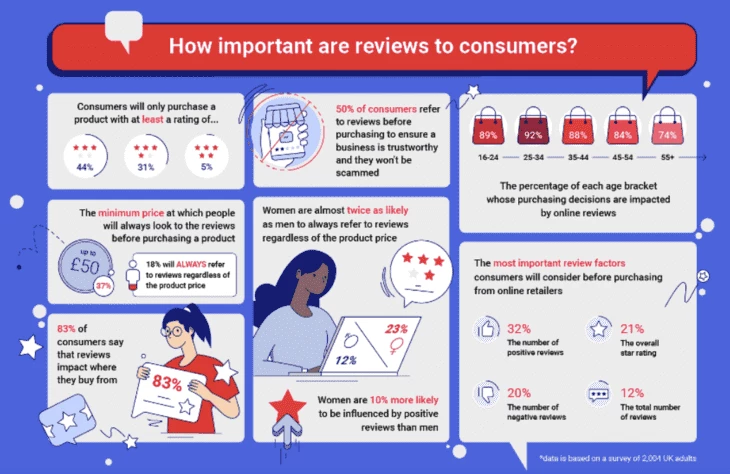
Source: Internet Retailing
What looks like “slow” is usually just the decision taking the long way. So between “Sounds good, I’m in!” and “Sounds good, now prove it”, female consumers will most likely choose the latter. And the bigger the consequences feel (the more it smells like “I’ll regret this later”), the stronger that verification reflex gets. Everything is double, triple and quadruple-checked. You can call it cautious or… annoying (if you are the one staring at the CVR graph). But it’s a real pattern you bump into when you send women into funnels built for speed.
Now look at how most affiliate funnels are designed. They try to compress time through urgency, countdowns, blunt CTAs and a general vibe of “don’t think, just do”. That structure can work great for fast decision psychology. With more meticulous users, it often does the opposite. Instead of nudging them forward, it flips a little switch in their head: “Wait. Why are they pushing me?” Ouch, we dive head first into an impenetrable armour of cognitive friction. The user doesn’t bounce because she “hates the offer”. She can’t help but slow down because the funnel is acting too eager.
Longer decision cycles imply that certain parts of a landing page can no longer be just for looks. Fence sitters rarely rush toward the CTA, they hunt for the second layer instead: check for specifics, scroll through FAQ and About Us sections to find out what happens next and “who are you people behind all this?”. Reviews also mean a lot, because they are not written by you, which is immediately a point in their favour. For this kind of audience, a deep scroll helps to reduce uncertainty.
And if you are wondering why women often behave like this in the first place, check out our article:

There, we talked about how women frequently carry a lot of the responsibility for purchasing decisions: household stuff, everyday spending, avoiding dumb buys, scams or hassle which can eat her entire week. When being wrong has a cost, people get picky. So if your funnel is built to reward speed and she is wired to reward certainty… well. That’s your leak.
Creative Mismatch: Shock vs. Narrative
Once you accept that a lot of female users hesitate before jumping straight to the CTA, the next question is: why are we still feeding them creatives designed for rushed decisions? Funnel behaviour and creative formats are parts of one system, after all. Your ad sets the tempo first, then your landing page keeps it and your audience either stays in this rhythm or drops out. Let us show you the difference between the creatives we all got used to and a bit more careful approach women tend to respond to:
What traditional affiliate creative often does | What female-friendly ad formats should do instead |
Instant claims: “You won’t believe this”, “Easy money”, “One secret trick”, “Stop scrolling and earn now”. | Narrative setup: “I didn’t expect this to work, but…”, “Here’s what I wish someone told me before…” |
Shock as the hook: bright visuals and aggressive angles (e.g. “You are doing it wrong!”) | Context as the hook: what it is, who it’s for, why it’s worth it (e.g. “If you are in this situation…”, “This is for people who hate…”) |
Big numbers as the main proof: ROI screenshots, huge percentages, “made $X in Y days”. | Demonstration over promise: screen recording, step-by-step, here’s how it works, what you get, what happens after you sign up, etc. |
Compression of time: “Ends tonight”, “Last chance”, “Limited spots”, “Expires soon”. | Lowering uncertainty: what it is + what it isn’t, what to expect, what people ask, here’s the catch (if there is one). |
Early CTA drop: button appears before the user even knows what’s going on. | CTA after confidence: the ask comes after the user has enough information to feel in control. |
Sounds like a pitch: the ad is performative, confident, loud, punchy and salesy by design. | Sounds like a person: less stage performance, the content is explaining through “here’s my experience” voice. |
As you see, the real difference here doesn’t come down to a myopic conclusion “women like stories” (please, no). The main point is narrative formats leave room for a decision a user can reach through some checkpoints. Shock formats, on the other hand, try to win before those checkpoints even appear. So when you pair impulse creatives with a sceptical audience who prefers to verify every detail, they often don’t get further than the first click. Aligning right creatives with “slower” conversion mechanics might remove that bottleneck from your funnel.

“Let Me Check First” Platforms and Formats
If you want to convert women better but, at the same time, only buy fast-feed traffic, you are already stacking the deck against yourself. There are platforms and content formats suitable for slower decision makers, where people can browse, save, compare, ask around, then decide when they are ready.

In online places like these, women show up in higher numbers and their thorough behaviour we’ve been talking about is normal out there, even encouraged. The trick is to connect this behaviour to those popular platforms and formats:
Pinterest. The most obvious choice, the whole point is discovery and saving finds and ideas in the form of pins (photos, videos) for later.
Instagram. Similar in browse-and-store-for-later behaviour, works best when the content looks creator-led and “save-worthy” (e.g. practical posts, walkthroughs or mini explainers).
Facebook. Good for people who make decisions with the help of the community, through groups, discussion and recommendations. People can come there to ask “has anyone tried this?” and actually listen to the answers.
There are also places that can’t be called predominantly female platforms, but where “sisterhood” formats thrive:
TikTok videos on lifestyle, wellness and finance literacy;
YouTube long-form reviews;
Email communities and newsletters;
Niche forums and discussion spaces.
Do you want female traffic to actually go somewhere? Then stop expecting every impression to close the deal, it won’t speed women up – you’ll just lose them earlier. We recommend following this sequence instead: discovery > narrative > comparison > decision. To make it clearer: the first touch gets your offer on the radar, the second one builds context, the third one answers the “yeah, but…” questions, and only then do you ask for the final click.

Funnel Adjustments You Can Test This Month
Swap urgency blocks for trust blocks. Take one version of your landing page and remove pressure elements like countdown timers or “last chance” banners. Replace that space with proof: real user feedback, clear terms, credibility signals. Then compare not only conversion rate, but also how people move through the page (time, scroll, exits around the CTA).
Make the FAQ do actual work, then watch how people use it. By this we don’t mean “What is X?” stuff, it won’t tip the scales. Add the questions people ask when they are hesitating: pricing surprises, cancellation, eligibility, what happens after payment, support. Track scroll depth, and if the FAQ gets attention, it shows the user intent, just in a different form.
Add a plain “What happens after I pay?” section. This part funnels usually love to hide. Bring it forward and explain the steps in normal language: what the user gets, when they get it, what it costs, what’s refundable (if anything), how to undo it if they change their mind. You may think it only adds friction, but it actually removes uncertainty which can otherwise hurt conversions.
Test a narrative pre-lander vs an aggressive straight-to-offer page. The entry point can completely change the journey. One path drops people on a hard sales page. The other warms them up with a short story + context (why this offer exists, who it fits, what to expect). The winner is the one that produces fewer “curious clicks” and more committed ones.
Retarget by engagement depth instead of just clicks. Build retargeting audiences based on behaviour showing thorough research: longer time on page, deeper scroll, FAQ opens, repeat visits. Then retarget with creatives answering the doubts. You are basically meeting the users where their brain already is.
Try a short educational sequence before the money talk. Email, messenger or any other method you choose should nourish confidence at every touch: explain, show, answer common questions, offer options. Only then push the click leading to payment. This approach works miracles when your offer is unfamiliar or the category’s got a bit of a sketchy feel to it.

Conclusion
Affiliate marketing has always loved speed. But as we’ve learnt today, a big chunk of female traffic converts through certainty instead of adrenaline. You’ve now got the channels to look at, the creative formats to prioritise and a handful of tests to run on your funnel UX. Good luck, and don’t be surprised if your “problem audience” turns out to be the easiest one to keep once you stop rushing it.