Traffic Cardinal
wrote March 11, 2026
Traffic Cardinal
wrote March 11, 2026
Traffic Cardinal
wrote March 11, 2026
Traffic Cardinal
wrote March 11, 2026
Ask around about sensory marketing and you’ll hear: “That’s for offline. We are online.” So… we’ve got visuals and some sound, as long as autoplay is working, right? Does that mean the human brain disables the rest of its senses when the browser opens? As if!
You can absolutely mess with more than retinas and eardrums through a screen with a bit of psychological mischief. By triggering memory and imagination, you can also make people feel texture, imagine taste and recall smell. Exciting, huh?
Today we’ll look at how sensory marketing works in a digital context, why even “tangible” senses can be evoked remotely, which niches you can use it for (you’d be surprised) and where you can fix your funnels to stimulate your audience into conversion. Stretch your creative muscles (we are about to use them) and read on!

Inside the Buyer’s Brain
What is sensory marketing, if not some kind of sorcery? Actually, it’s more scientific in its nature: advertisers use sensory cues (sight, sound, touch, smell, taste) to shape certain perception and behaviour among their target audience. And would you believe it, this trick really works! The customer’s brain gets involved before their “rational adult” wakes up, and just like that – snap, the trap closes shut. Studies also suggest that when you stack those cues to make the experience multisensory (instead of just one lonely stimulus), offers look more appealing and people show stronger intent to buy. It might sound like manipulation (because it kind of is), but the more senses we use to interact with a product, the more it feels like it’s already ours. Our mind gets fully absorbed by the idea of ownership, which makes walking away harder – just what marketers need.
None of this brain-hacking is new, by the way. Offline businesses have been poking at our senses for years – walk through any retail space or service area and you’ll see this logic in action. Casinos erase clocks and windows so the outside world fades away and the tables keep calling. Supermarkets slow the music down for you to stroll the aisles like you’ve got nowhere else to be, which, conveniently, leads to a fuller basket. The smell of freshly baked bread near the entrance nudges hunger before you even reach the produce section. And furniture showrooms make you sit on everything, sink in, run your hand over the fabric, test the cushions and even lie down “just for a second”... Voila, you are already imagining this random sofa you didn’t care about a minute ago in your living room.
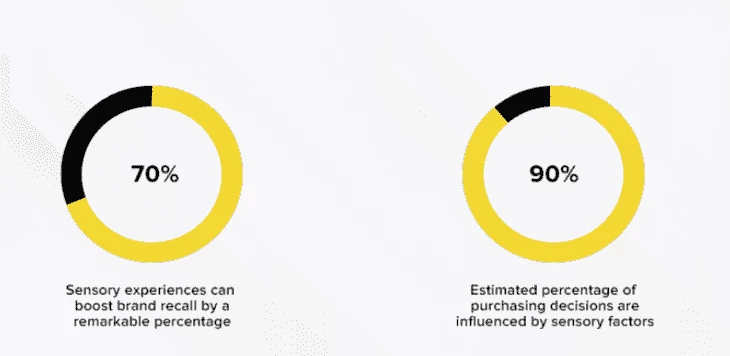
Source: X-Verity
Now, it’s tempting to think the internet got the short end of the stick here. No smells, nothing to touch or taste… What a bummer! But the screen isn’t nearly as handicapped as it looks. The human brain doesn’t work that literally and if you give it that cue we discussed earlier, it’ll happily fill in the rest. A well-shot close-up makes you almost feel the texture of fabric, the fizz of a drink in a video wakes up your taste memory and a couple of well-chosen words can bring back the smell of coffee or the sting of winter air. Mobile devices can also add a physical nudge with subtle vibrations and haptic feedback – not bad for a piece of glass. So with sensory marketing, the digital experience can feel a lot less flat than people assume. Well, now we just have to learn how to use it!
Five Senses, One Screen
To further convince you that digital can compete with offline in sensory marketing, let's look at how each sense can be imitated or evoked online.
Sight
All affiliates use visuals, but that doesn’t mean they are already doing sensory marketing. For creatives to hit like a sense, there has to be another level to it. You can start with texture – give people something their brain can “touch” with their eyes. How exactly? Zoom in until the viewer can practically feel it: close-ups of materials, textures and surfaces; for non-physical offers, you can add a bit of grain to charts and other infographics to make them feel tactile and dimensional. While we are on the topic of design, you can also use motion to make UI elements behave like they would in the physical world: buttons press in, toggles snap, cards flip with weight and sliders – yes, they glide, with noticeable drag. Colour choice matters just as much. Sure, you often have to stick to the advertiser's palette in your creatives, but it's also about the mood a colour creates and the message it intuitively sends. To learn more about colour symbolism in marketing, check out this article:
Sound
Okay, we discussed the face of your funnel, now let’s talk about its pulse – sound. You can either use it wisely or get yourself muted forever. We gathered here today to make sure you avoid the latter. Sound gives your offer emotional direction and basically determines how a user feels about it, whether it seems safe or sketchy, calm or chaotic. Little cues tell their nervous system what’s happening: sound effects inside apps, notification tones, UI clicks, voiceovers, audio-focused pre-landers, podcast-style pitches or reassuring testimonials. So no, you don’t need a full soundtrack for your affiliate campaigns, a few well-placed cues are enough to tell the body “this is good”, even before the brain reads the text.
Touch
Touch online might sound like a bad joke at first. How are you supposed to make users feel it through the screen? But phones have already solved a good chunk of this problem. Haptic feedback or, in other words, soft vibrations after a deposit, a trade, a bet or any other successful action give the user’s brain a physical confirmation: that just happened. The rest comes from imagination. We’ve previously mentioned motion design tricks, but words work just as well. Describe something with the right epithets and the body remembers it, filling in sensory gaps: silky fabric, crunchy snacks, cool glass sweating on a hot day, the weight of metal, etc. Nothing is technically “touchable”, yet the brain feels otherwise. And with newer technologies like AR headsets, making something feel “real” is closer than ever – we explored that in more detail in this article:
Smell
This one is a real head-scratcher, because no, you still can’t pump perfume through Chrome. Not yet, anyway. However, smell lives in memory more than in the nose, and memory is very easy to wake up. A simple phrase like “freshly ground coffee” makes you recall the scent and you don’t need actual molecules floating in the air for it. The same goes for an image of a poolside scene – it inevitably brings the smell of chlorine and sunscreen along for the ride. Visual or verbal cues can summon an entire atmosphere and carry scent with them: old libraries, kitchens, spas, beaches, forests, the list goes on. The brain will always supply the aroma.
Taste
Though it’s the toughest sense to pull off online, all the previous examples slightly hint at the fact it’s still doable. In nutra, wellness and anything remotely edible, the trick is to lean into flavour and mouthfeel until the brain starts salivating on its own – creamy, crisp, fizzy, smooth. If you pair those words with visuals, that’s even better: texture close-ups (yep, again, it’s our go-to), bubbling drinks, bites being taken with an audible crunch. A little ASMR never hurts. And even when the offer itself isn’t “digestible” (finance, iGaming, dating), taste still sneaks in through lifestyle cues: a glass of wine on the table, cocktails at a rooftop bar, dinner for two – they signal comfort, pleasure, indulgence and the good life your offer supposedly leads to.
How Sensory Marketing Works in Your Niche
Nice theory, but what does it look like in the wild? Let’s look at the sensory hooks you can use:
Finance and Investment
Clean visual hierarchy, stable colour palette and predictable micro-interactions in apps and on the web;
Soft sounds or haptics in explainer videos, interactive quizzes, ROI calculators, demo screens or investment simulators;
Copy promising relief and “felt” outcomes: “get a full night’s sleep without checking your dashboard”, “let your money grow in peace”, “no sweaty palms every time the market takes a turn”.
iGaming
Click and spin sounds, short win cues or light vibration in promo videos, demo reels, interactive pre-landers or bonus quizzes;
Visual micro-animations in creatives and landing pages: near-win moments, filling progress bars, rising multipliers or other little tension-builders;
Using sensory verbs in your copy: “watch the symbols line up”, “hear that bonus round calling”, “see what’s waiting behind the next click”, “tap to try your luck”.
Nutra and Wellness
Texture visuals: powder dissolving in water, serum sinking into skin, gummies slowly pulled apart, capsules poured into a palm, droplets running down a bottle;
Descriptive copy of taste, smell and feel: “mild citrus without medicine aftertaste”, “light herbal scent”, “no sticky residue”, “soft chew, not rubbery”;
Background soundscapes in video creatives: waves, birds, quiet gym hum, spa ambience.
E-Commerce
360° views, videos of a product in use, focus on how it moves, bends, crinkles and reflects light;
Emphasis in copy on weight, texture, material (“cool metal”, “buttery leather”);
UGC reviews mentioning sensations: “doesn’t squeak”, “smells neutral”, “fabric isn't plasticky”.
Education
Progress bars, checkmarks and little completion animations in mockups, landing pages or promo visuals to create a physical sense of “moving forward”;
Audio: calm tutor’s voice, page turns, keyboard taps, correct-answer sounds in demo lessons or quiz creatives;
Copy describing mental or physical relief: “no knot in your stomach when you see an exam question”, “finally stop clenching your jaw about English grammar”.
Dating
Profile previews in creatives, voice snippets in promo videos, audio teasers, short video testimonials or “hear their vibe before you match” angles;
Copy evoking sensory moments and atmosphere: “the buzz of a bar”, “ice clinking in late-night cocktails”, “the smell of rain on your jacket”, “that slow walk home when neither of you wants the night to end”;
Light haptics in swipe pages, dating quizzes, story ads you tap through or other interactive promos.
Building Sensory Funnels
Here is how you can engage your audience’s senses with just a few tweaks:
Step 1: Audit your current funnel for sensory flatlines:
Where do users see something? Is it just flat graphic and text or is there visual depth, motion or texture?
Where do they hear anything? Is it deliberate or random stock music?
If they are on mobile, does anything use haptics?
Does your copy ever reference touch, taste, smell, body sensations, or is it 100% numbers and adjectives?
Step 2: Rewrite your creatives with sensory language:
Take your top headlines and add physical or sensory wordings. For instance, “Fall asleep faster and wake up without heavy eyes in 7 days” is much more convincing than “Sleep better in 7 days”;
In ad copy and pre-landers, add short sensory scenes: “Your phone buzzes. It’s not another bank fee, it’s much more pleasant – your dividend payment”;
Make sure at least one line mentions a body feeling (warm, cold, light, heavy, relaxed) or a concrete sensory detail (sound, smell, texture).

Step 3: Connect online promises to offline sensory proof:
Encourage actions with sensory payoff: “Book a call and notice how your shoulders drop once someone competent explains the investment to you” or “Order your first supplement pack and if it tastes like medicine, send us an angry email”;
In case partners allow it, push free samples, trial sessions or first deposit bonuses, so that users can truly connect with the offer.
Step 4: A/B test sensory elements:
Test sensory vs non-sensory copy blocks on the same visual;
Compare creatives emphasizing different senses in the same campaign;
Apart from CTR and CR, also track scroll depth, time on page, video completion.

Conclusion
The funny part is, sensory marketing online still gets underused, even though the tools are right there. To make your funnel the opposite of flat, you just need a bit more intention and imagination than the average affiliate seems willing to use. Now you know better. So take what fits your niche and make it feel like something. Good luck and may your next campaign hit a nerve in the best possible way!