Traffic Cardinal
wrote February 27, 2026
Traffic Cardinal
wrote February 27, 2026
Traffic Cardinal
wrote February 27, 2026
Traffic Cardinal
wrote February 27, 2026
Amazon, by itself, is a household name, recognized by both affiliates and ordinary people who use it to purchase a wide range of products from pillowcases and houseplants to 3D printers and Madagascar cockroaches. But only the chosen ones — the interested ones, that is — know that the feared and revered Amazon has an affiliate program that can change the perception of affiliate marketing once more. But what is this affiliate program? How is that any different from all other options available on the market?
Let us take the floor once more and wax eloquent on this subject in detail.
What Is the Amazon Affiliate Program (Amazon Associates)?
The most logical way to start the article is to answer the question hanging in the air: What is Amazon Associates, the affiliate program we’re covering in this article?
Well, it’s a relatively unique performance-based solution, allowing bloggers (and vloggers, obviously), creators, and online publishers to earn referral fees by promoting products listed on Amazon. You may’ve bumped into links on your favorite blogger’s feed — if you clicked one such link and made a purchase using it, your favorite blogger received a commission. This program is increasingly popular among all sorts of creators for many reasons: first, this is Amazon we’re talking about, so it’s legit; second, it’s free to join; and third, it’s open to individuals and companies.
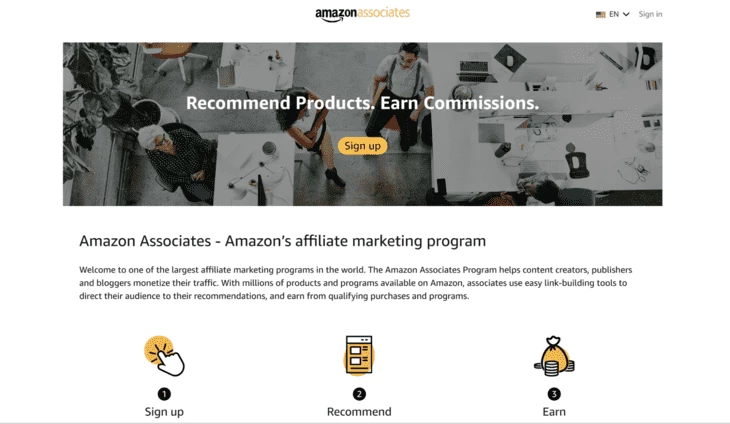
How Amazon Affiliate Marketing Works
Are we onto something? Because if you’re seriously considering this affiliate program, you should scrutinize following paragraphs, starting with how to sign up for amazon affiliate program and gradually segueing to more complicated topics.
Registration and approval process
Nothing transpires out of thin air — unless you’re a panspermia theory supporter. As usual, you need an account with the platform of interest: state your purpose, submit information on your website or social channels, explain how you drive traffic, and describe promotional methods you’re planning to use. Once your application is approved, you may start your campaign.
Product selection and affiliate links
Amazon affiliate marketing program centers on the product selection represented on the marketplace: bloggers — who undoubtedly know their audience well enough to draw conclusions on its tastes and preferences — choose relevant products from the catalog. Using the tools built into the platform, “newborn” affiliates can create custom links leading to specific product pages.
Traffic → clicks → commissions
How does Amazon Affiliate work? We’ve previously mentioned that it’s a performance-based solution for any blogger, who wants to monetize their endeavors, so, essentially, everything depends on your strategy. From a purely technical point of view, the process is easy to grasp: you publish content with referral links, your audience clicks the link, sends the product to the shopping cart, and completes the purchase. When the sale is processed and confirmed, you — the affiliate, or the blogger — receive your commission.
Cookie duration and attribution model
Speaking of commissions, there’s one thing you should know before you throw yourself headfirst into Amazon campaigns.
The commission system on the platform is determined by a tracking cookie that records user activity each time they click your referral link. Typically, affiliates registered in the system earn a percentage of qualifying purchases made within a limited timeframe; in other words, affiliates can benefit from selling the product they initially promoted and from other eligible products bought during the cookie period.
Amazon Affiliate Commission Rates
Those who shyly pried into the depths of the Amazon Associates affiliate program may have come across certain commission rates, stated in the platform’s policy guidelines — some are 1%, others hit the benchmark of 10%. We decided to summarize the findings to save you some time.
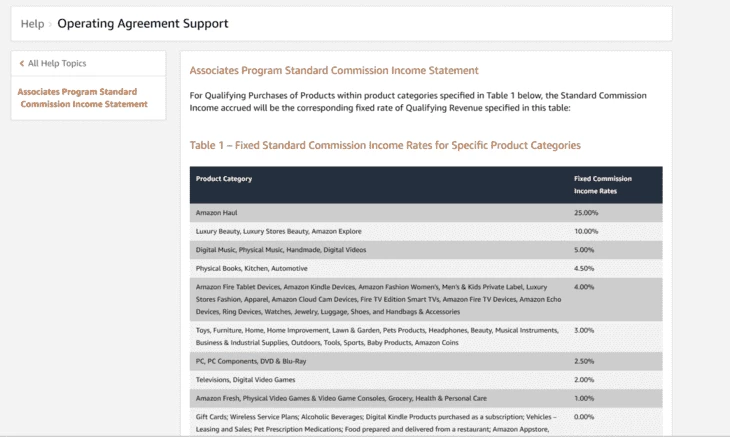
Commission structure by category
So, Amazon commissions are strictly categorized, meaning affiliates earn different percentages for different types of products: luxury beauty products tend to have the highest rate (around 10%), and everyday items like popular electronics or home decor-related stuff normally gets closer to 4%. You might want to adjust your content to promote the most lucrative options, but experts claim it’s better to balance your strategy and determine which Amazon affiliate products can reflect your values and spur your audience into action.
Fixed vs variable rates
Quite possible, you’re a seasoned specialist, who’s tested a variety of platforms — and, quite possibly, all of them offered fixed rates per action. What defines affiliate marketing with Amazon is flexibility: here, the rates are tiered by product type, so your commissions won’t be the same for every sale — you basically earn a percentage of what customer spend within a given commission bracket rather than a flat fee for all referrals.
How commissions have changed over recent years
It would be unwise to think that Amazon — practically a mogul amongst the moguls — never revised its commission policy. In fact, it happened more than once: some categories saw downward shifts, reflecting changes in the platform’s priorities and market conditions. However, Amazon still remains a perfect option to monetize content: all bloggers who want to know how to earn commission on Amazon need to do is to stay updated and optimize their strategy, sometimes opting for more remunerative options, and sometimes count on volume.
How Much Do Amazon Affiliates Make?
An aspiring Amazon affiliate is always the nosiest: not only do they want to know the technical part and the inner processes, but they are also curious as to the actual sums and whether it’s all worth the effort. As much as we want to give you the accurate range, we can’t provide detailed information — it’s so diverse and inconsistent. Earnings vary greatly, but the platform’s report claims that the average annual income can be around $80,000 per year, which is, obviously, the ideal number. Of course, there are magins, too: the most successful influencers earn over $110,000 annually, and the greenhorns might obverse lower much lower figures at the beginning.
Beginner vs experienced affiliates
Elaborating on the previous thought, it’s safe to say that beginners tend to start modestly: perhaps, a few hundred dollars a month at best. In contrast, more experienced affiliates with a loyal follower base, solid traffic sources, and established content, the numbers are much better: the income can often reach thousands of dollars per month.
Earnings by niche
Everyone punching the query “Amazon become an affiliate” into the search bar must understand two fundamental truths: first, that the income varies in general, and second, that the income varies depending on the niche you choose. As a rule, niches with higher-priced products or frequent purchases (home, technology, fitness & beauty) tend to attract more customers and often result in higher commissions. It should not come as a surprise: the trick is that buyers in these categories are more likely to purchase expensive items, which correspondingly leads to a total payout increase.
Earnings by traffic source (blog, YouTube, social media)
Ponder over the steps you’re mapping out: sometimes building an Amazon affiliate website doesn’t work as smoothly as an established YouTube channel. Your strategy defines your budget and may determine how much you’re going to earn: blogs with strong SEO can deliver steady traffic and consistent clicks, but YouTube videos and socials can provide bursts of clicks. You can test different approaches, but most experts recommend diversifying your traffic sources and adjusting content depending on your audience’s — buyer’s — behavior on different platforms.
Amazon Affiliate Program Requirements
Now that you are more or less educated on the subject, it’s time to dwell on the Amazon requirements. In general, the platform simply expects you to have a public platform with original content where you can share your links. However, there’s one unexpected — thought perfectly logical — demand: you must generate at least three qualifying sales within your first 180 days after approval to remain in the program.

Website requirements
How to be an Amazon affiliate if you have your own site? A few things to consider: this website of yours — or blog — must be publicly accessible, have original content, and contain at least 10 posts that have been recently published to show that you are a consistent user and have valuable information to share with your visitors.
Social media & YouTube eligibility
Becoming an Amazon affiliate through socials — Facebook, Instagram, YouTube, Twitter, and other such platforms — is a little different: your profiles must be public and have an established audience and engagement (usually it implies approximately 500 genuine followers).
Mobile apps and other platforms
Mobile apps can also participate, but if you’re pursuing this avenue, keep in mind that your app must be freely available in major app stores (Amazon, Google Play, or Apple Store) and contain original content that does not replicate Amazon’s storefront interface.
Content and compliance rules
All in all, there’s a very clear set of rules on how to do affiliate marketing with Amazon: avoid unsuitable content (explicit and discriminatory) and disclose your use of referral links, explaining that you may earn commissions from qualifying purchases.
Common Reasons Amazon Rejects Applications
What is Amazon affiliate program? Essentially, a way to earn money. Can your application be rejected? Sadly, yes. Although official reasons are kind of clandestine and rarely — if ever — mentioned, it is not impossible to discern a general pattern and come up with a shortlist.
Insufficient content
How to become an Amazon affiliate? Sign up, create content, and attract customers, if we’re brief and concise. But should your content meet a certain requirement?
One-word answer: yes. Two-word answer: insufficient content. Deciphering this one: your blog does not provide high-quality material and unique insights, so Amazon does not see enough value for customers and rejects your application, thus prompting you to take action and update.
Policy violations
Amazon’s policies are strict, if not to say rigorous, but if you’ve made up your mind and decided to do business on this platform, you must abide by the rules, even the ones you don’t like: you don’t know how to create an Amazon affiliate link and find a sleazy shortcut? Rejected. Resort to non-tagged or cloaked links? Rejected. In other words, read the guidelines carefully to avoid misunderstanding and complications.
Low-quality or copied traffic
Forget about low-quality traffic sites with little organic engagement or content scraped from other companies or Amazon itself — it will literally lead you nowhere, unless your destination is a rejection. This platform is willing to pay only when you contribute to customer discovery.
How to reapply after rejection
If your application was declined, that certainly confirms a statement no one wants to admit: your marketing strategy sucks. It might have one minor flaw that requires attention, or you should fully invest in searching for the problem that derailed your plans. But that shouldn’t stop you: once you solve said problem, you can reapply — according to the platform’s current policy, any applicant can rejoin after fixing the issue. However, repeated violations may require additional approval, so be prepared.
How to Become an Amazon Affiliate: Step-by-Step Guide
You don’t know how to join the program? Not sure how to get an Amazon affiliate link? Feeling lost, perhaps, because it all seems a little overwhelming at the moment? Relax and count to ten: we’re going to talk you through the process, step by step.
Step 1. Sign up on the Amazon Associates website
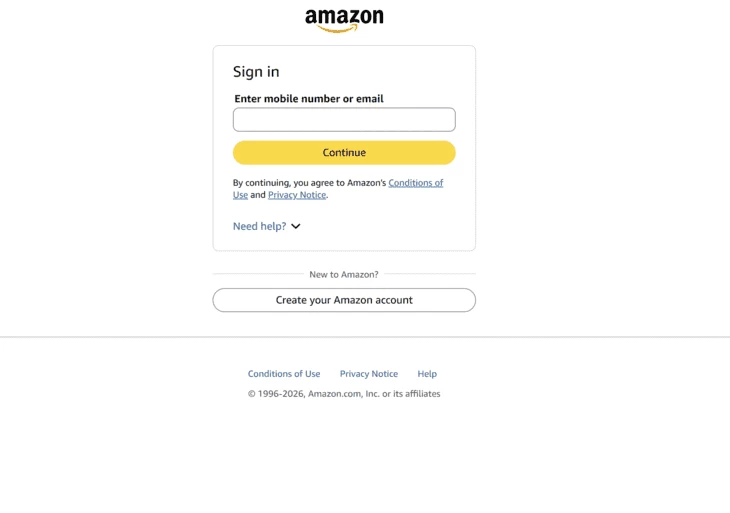
This should be easy: visit the Amazon Associates homepage and click the Sign In button. The window will give you two options: you can either log in with your existing profile or create a new one.
Step 2. Enter account and contact information
Submit your personal details: your name, address, and phone number. That’s a reluctant step, understandable, but accurate information in all these fields helps Amazon verify you as a partner and, eventually, approve you and your upcoming campaign.
Step 3. Add your website, app, or social media profile
State your channels — platforms you’re going to use: URLs, mobile apps, socials, that sort of thing. The idea is to clarify the aspects of your campaign and demonstrate how you’re going to sell products to your audience.
Step 4. Set up your store ID
Once your platforms are listed, you’ll be asked to create a store ID — an identifier that represents your affiliate storefront. This unique ID tags your performance data and helps track which of your promotions lead to actual sales.
Step 5. Describe how you will drive traffic
Essentially, you are asked to point out the general steps of your strategy: elaborate on how you’re planning to attract visitors and generate clicks, share your ideas on promotions on how you expect to convert visitors into buyers, convince Amazon that you’re serious and intent on driving the profitable performance it seeks.
Step 6. Choose a payment and tax method
The money part is always a little thrilling: you’re already picturing the enormous payouts you’re receiving from Amazon. Select the preferred methods (Amazon gift cards, check, or direct deposit) and fill in the details on tax information.
Step 7. Get approved and make your first sale
Success is just around the corner if you did things right. When you submit your application, it is dispatched to moderators who gauge it and, if everything is by the book, approve it. Next, you gain access to the dashboard, where you can finally generate and share your links. Once you make your first qualifying purchase you’ll begin earning commissions.
How to Create Amazon Affiliate Links
That’s your setup! Affiliate campaigns on Amazon start with approval and are largely focused on affiliate links, which is why we want to examine the process in detail.
Product Link Tool
How to create Amazon affiliate link? It would be unwise to ignore the simplest option — the Product Link Tool, embedded in the dashboard. Power up the tool, find the product you want to promote, and get the desired link that you can place on your website.
SiteStripe (desktop and mobile)
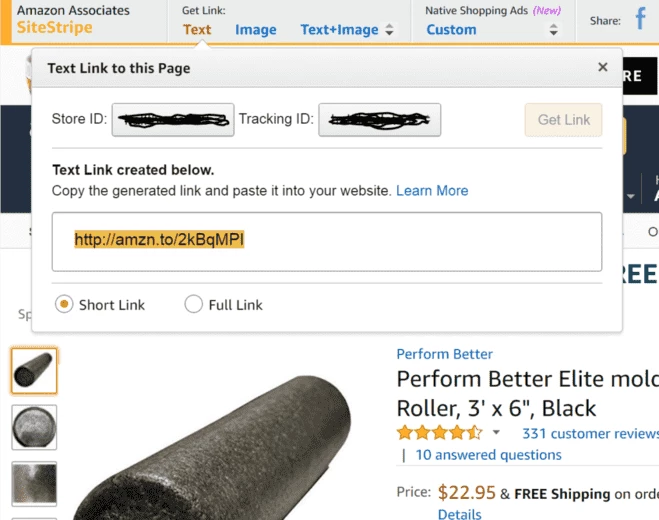
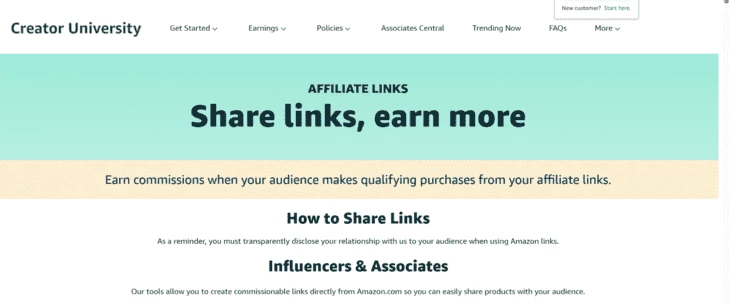
Another simple way for earners to generate affiliate links is SiteStripe, a bar that appears at the top of Amazon’s page when you’re logged in. With SiteStripe, you can create text links, image links, or shareable links directly from any product page — and on mobile, Amazon’s GetLink feature works similarly through the share button.
Banner and native shopping ads
In addition to individual product links, Amazon also offers prime promotional units — banners and native shopping ads. Their advantages are self-evident, but we’ll spell them out anyway: they automatically evince relevant products and include your affiliate tracking code, so you can showcase your product in a visually appealing way across all your platforms.
Using multiple tracking IDs
Once you’re regularly creating affiliate content, it’s wise to use multiple tracking IDs across your links. Amazon allows affiliates to generate up to 100 ID variations, so you can tag and analyze which traffic sources (e.g., blog vs. social media) drive more sales.
How to Promote Amazon Affiliate Links
Strategy is key, but with giants like Amazon, the strategic avenues may not be as obvious: this is by far one of the most pernickety and demanding affiliate programs, so you should be extremely attentive.
SEO-driven product reviews
If we were to draw up a list enumerating tips that would help you nail an Amazon campaign, SEO-optimized reviews would be a solid number one. Technically, that is the list, and technically, this is the number one we’ve just mentioned, so consider creating informative reviews that answer common search queries and include your affiliate links where readers naturally expect them.
Comparison and “best of” articles
Have you ever thought of posting comparison articles or lists containing top-picked products? Perhaps it’s your cue to start. Apart from the self-explanatory advantage — you can cram several product options in one such article — it has another benefit: these guides often rank better in search engines.
YouTube videos and Shorts
Although it’s a rather contentious statement to announce, we will do it anyway: nowadays, people seem to prefer videos over texts. Seize the opportunity with both your hands, and include your Amazon links in descriptions and pinned comments for all viewers to see.
Social media posts and stories
Social media posts and stories are free and require practically no skill: whenever you are out and about doing something — anything, actually — you can feature a product, describe its benefits, share insights, and mildly nudge people to click the link in your bio or underneath your post.
Email marketing (allowed use cases)
Yes, Amazon’s affiliate policies limit how you use links directly in email newsletters, but you still can send subscribers to your blog posts or YouTube videos that contain affiliate links — for example, by sharing a roundup of product recommendations on your site.
Affiliate Marketing Strategies to Increase Amazon Earnings
It would be so easy if you could just slap a few links on a page and wait for customers to check them out!.. Alas, it doesn’t work that way: again, you need a strategy. And again, we’re coming to the rescue.
Choosing a profitable niche
You know your audience? Good. But it’s much better to know which niche would align with your audience’s needs and preferences and which products they would most likely buy using your links. In other words: scan the data, explore the demand, scrutinize the trends before you actually set sail and make up your mind.
Targeting buyer-intent keywords
Is someone ready to make a purchase? Optimize your content and target buyer-intent keywords to find out and rank higher in search results — closer to the positions where users are more likely to make a purchase.
Creating original, helpful content
That has been said here and in other articles, but the subject has to be broached again: original content — comparisons, tutorials, product reviews, guides, etc. — is your bridge between you and your audience. Of course, it builds trust, no arguing here. Additionally, however, it increases the chances that your followers will rely on your opinion and engage with your links.
Optimizing for mobile traffic
It’s too early to draw conclusions for the entire world, but it won’t be an understatement to say that people are using smartphones just as frequently as computers, if not more. With that in mind, optimize your campaigns for mobile traffic: whatever content you create, make sure everything works smoothly on mobile devices and does not fall apart whenever a user clicks your referral link.
Using geo-targeting and link localization
Another effective strategy is GEO-targeting and link localization. These little tricks ensure that international visitors are automatically directed to the Amazon marketplace specific to their region and help you register purchases from global traffic.
Pros and Cons of the Amazon Affiliate Program
The article wouldn’t be comprehensive enough if we failed to cover the crucial bits — advantages and disadvantages of the platform.
Pros
You can figure them out yourself: Amazon is a fairly big marketplace with a large variety of items you can promote — even if you’re on the weirdest side of the internet, you will most likely discover something that resonates with your audience. That would be the vital one. Then, Amazon is a trustworthy platform that supports various link tools and integration options, so the processes should not be particularly difficult even for the most inexperienced affiliates.
Cons
Alas, Amazon has its own downsides. Commission rates might be the most disappointing of them: they are often lower than usual, and the tracking cookie window is relatively short — usually around 24 hours — which can limit commission potential unless a purchase happens quickly after a click. Besides, Amazon is notorious for its stringent conditions and rigorous operating guidelines, so the earnings can be impacted by returns or cancellations.
Amazon Affiliate Payments
In the following paragraphs, we’re going to cover all financial aspects.
Payment Methods
Amazon Associates offers a few ways to receive your earnings: you can obtain an Amazon gift card, get paid by a check mailed to your address, or choose a direct deposit into your bank account. However, each option implies a minimum payout.
Minimum Payout Thresholds
As stated above, each payout option has its own payment threshold. Gift cards and bank transfers typically require a minimum of around $10; checks imply more serious sums, starting with approximately $100. If your earnings don’t meet the minimum in a given month, they roll over to the next month until the threshold is reached.
Payment Schedule and Delays
Amazon has a schedule: payments are usually made about 60 days after the end of the month in which the commissions were earned. For example, all commissions earned in January will most likely be processed and paid at the end of March.
Returns, Cancellations, and Chargebacks
Affiliate commissions reflect actual sales, and while it gives you an alluring percentage, it also comes with a downside: returns and cancellations may affect your income. If a referred purchase is returned or refunded, the related commission is typically deducted from your future payouts, since Amazon only pays on completed, final orders.
Is the Amazon Affiliate Program Worth It in 2026?
You’re nearing the end of the article, and you probably expect a verdict on whether you should give it a shot or forget Amazon forever. But we are not silent judges — the decision is always up to you. What we can do, however, is to glean additional bits to help you rule it out completely or accept the opportunity.
Who Should Start
Those who have an established platform with regular traffic, that much is clear. If you have a blog, a site, or a social media account with an engaged audience, you can use Amazon to monetize the content you post.
Who Should Consider Alternatives
At the same time, if you’re working in a niche that involves high commission categories, long sales cycles, or you expect immediate income from affiliate sales, you might consider supplementing with programs offering higher commission rates, longer tracking windows, or different payout structures, since Amazon’s cookie duration and rate variability can limit earnings potential alone.
FAQ