Traffic Cardinal
wrote May 06, 2026
Traffic Cardinal
wrote May 06, 2026
Traffic Cardinal
wrote May 06, 2026
Traffic Cardinal
wrote May 06, 2026
Sometimes a 20-year-old builds something so cool that people start acting as if the next decade has already been decided and we are just waiting for the press release. One minute it was a fresh name climbing through GitHub, the next it was being discussed like some new species of machine that might know what people will do before they do it. The internet loses its mind, investors are hovering… That’s, more or less, what happened to MiroFish.
Naturally, that kind of thing gets attention. Affiliates, though, have heard exciting promises before, and most of them didn’t exactly pan out. That’s why we won’t be pretending this is a battle-tested marketing weapon already. It isn’t, at least, for now. The project is new and the evidence is still thin, so we’ll do something more useful instead: look at what MiroFish is, how it differs from ordinary forecasting, where it could be helpful in affiliate work and why the hype might be getting ahead of reality. Dare to peek into the AI crystal ball? Come on, then!

What is MiroFish?
While most of us still lose dignity every time Bluetooth refuses to connect, another genius undergraduate went ahead and built a prediction engine with life-changing ambitions.
MiroFish was created by Guo Hangjiang, also known online as BaiFu, a senior student at Beijing University of Posts and Telecommunications. Before that, he had already built BettaFish, a multi-agent public-opinion analysis project that also went viral on GitHub, so this was not his first fish-shaped brainchild. It all came together in about ten days with the help of AI-assisted vibe coding (it’s 2026, baby, you haven’t heard the last of this thing, that’s for sure), then made it to the top of GitHub’s global trending list and started collecting tens of thousands of stars super fast. The money to support the project’s development arrived just as quickly.
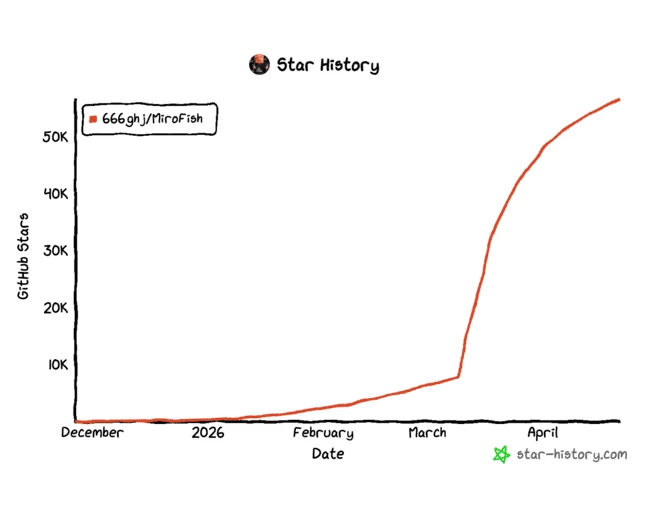
Source: GitHub Star History
So, how does this MiroFish work? The short version: this multi-agent prediction engine runs simulations based on real-world context. You give it input: in affiliate terms, that could be a landing page draft, offer description, positioning angles, competitor messaging or any other work-related rabbit hole you’d like to go down. Then you ask a question in plain language: “How will this play out?” or “What happens if we change this part?” From there, MiroFish builds a system around that material and populates it with agents. Can you guess how many? Hundreds, sometimes thousands of them. Each one gets its own role, a perspective, bits of memory and ways to make decisions. And just like people, they don’t move in sync. On the contrary, they interpret the input differently, react to each other, reinforce certain ideas, push back on others and evolve as the simulation progresses. Uncomfortably familiar, huh?
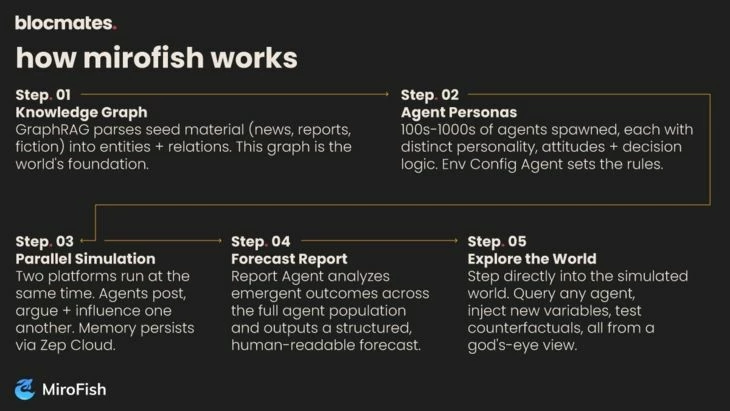
Source: Blocmates
Once the agents are done arguing, MiroFish turns the mess into a readable report: where the agents mostly agreed, where they split and what patterns stood out. But that output is not where it stops. You can ask follow-up questions, dig into specific parts of the result, adjust the input, introduce a new variable and run the scenario again.

Is MiroFish Different from Ordinary Forecasting?
Forecasting tools are history readers: you give them past numbers, define a few variables, in certain cases add some assumptions and they try to tell you what is likely to happen next based on what already happened before. It’s undoubtedly useful, but this kind of forecasting works best when your question is relatively clear. Those tools won’t have a problem telling you about traffic trends, conversion rates, seasonality, budget shifts or cohort behaviour, as long as it can all be squeezed into spreadsheet rows.
MiroFish comes at the problem from a different angle. It’s more interested in how different people might react once your campaign is out in the wild. No dashboard is capable of summarising all the messy human “nuances” which make affiliate launches fun in the same way stepping on a Lego is fun. A user sees the promise, another user doubts it, someone gets excited, someone gets suspicious, the message travels, mutates, hits a nerve, misses the point or creates a reaction nobody planned for. MiroFish is trying to simulate that.
So no, it’s not exactly a replacement for the tools you use to track performance because they look at what really happened. MiroFish is better viewed as a sandbox for questions where human behaviour can make or break the result: how your audience might read an angle, where your funnel might trigger friction, how a claim might spread or which assumptions could be proven wrong once people get involved.

How Affiliate Marketers Can Use MiroFish
Alright, now let’s see where this mysterious lil’ fish can fit into your marketing routine.
The first obvious use is pre-checking your creative angles. Before you build a batch of ads around one bold claim, you can feed MiroFish your offer details, audience notes, a few angle options and then ask how different user types might react. However, the point here is not to crown a winning creative from the sofa. Your goal is to catch the possible cracks early. Does the promise sound exciting but also suspicious? Does the hook attract the wrong kind of curiosity? Is this emotional angle convincing but only until a skeptical user starts pulling at the thread?
Landing page objection mapping might be even more useful. Sure, pages might look fine when you or your team review them, because everyone in the room already understands the offer. But that’s the cognitive trap right there. With enough seed material (your page draft, offer notes, user pain points, reviews or a couple of existing complaints), MiroFish could help you spot the places where the page begins to wobble.
Another possible use is GEO and segment adaptation. But don’t get delusional about it, because you’ll still need local knowledge, thorough research and preferably someone who can tell you when your “adapted” message sounds off. MiroFish can sit before that stage as a rough filter. You can feed it your seed material like earlier, but this time ask what may need changing before you reuse it. It might point to payment doubts, odd wording, missing context, habits you didn’t account for or parts of the offer requiring more explanation.
For verticals where, metaphorically speaking, you walk around with gasoline and every now and then things catch on fire, MiroFish might offer some room for backlash rehearsal. Let’s say your funnel leans on a bold promise, sensitive topic, aggressive urgency or any other detail that might look shady in the wrong light. In this case, running it through a simulated reaction loop could help reveal what people might object to first. Not that we are trying to convince you the internet is predictable. Quite the opposite, really. But if a claim is likely to trigger suspicion, mockery or complaints, better to meet that version of reality before launch than in the comments or support tickets.

You can also use MiroFish as a framing test for your content. Don’t rush to publish a review, advertorial, comparison or guide until you check whether the narrative leads readers where you think it does. AI agents can be your perfect focus group and collectively decide if your piece creates interest or triggers suspicion and if your bread-and-butter CTA reads naturally or… a little desperate.
Important note: all of this still sits below actual testing. MiroFish can’t tell you what your tracker will tell you and it definitely won’t replace the rude honesty of live traffic. But it may help you waste fewer tests on ideas which were already limping at the concept stage.
What MiroFish Can’t Promise Yet
It’s worth drawing a line around what MiroFish is not, before we get too excited and start mentally plugging it into every affiliate workflow. Simulated AI agent feedback doesn’t equal market truth and the more your question depends on hard numbers, the more careful you need to be with the answer. So far, MiroFish looks more useful for exploring possible reactions and weak spots. But producing final decisions you can safely hand to your budget is quite risky.
That’s why we need to be clear about the caveats. Otherwise, it’s too easy to confuse a promising idea with a proven one:
There is still not enough public proof that it consistently predicts real outcomes better than existing methods. Sure thing, the project and its viral launch are exciting, but that doesn’t 100% imply the results are reliable.
The quality of your input shapes the final results. If the seed material is vague, biased, too thin or based on wishful thinking, the output will be built on bad context and lead you down the wrong path (even though it may sound polished and convincing).
The agents are still artificial. They can imitate disagreement, persuasion, social pressure and changing opinions, but they are not real users.
Bias can creep into the simulation itself. Agents may reinforce the same assumption, lean into the same wrong idea and produce a confident consensus that looks way more picture-perfect than reality would ever be.
The project is too young, so you’ll need a lot of tech knowledge and patience to survive a product that has not yet been smoothed down for every casual user.
Be careful with sensitive materials. Funnels, offer docs, compliance notes, revenue data or anything normally staying inside the team shouldn’t be uploaded blindly until you check how the tool handles privacy.
Source: MiroFish
This is also why we aren’t turning this piece into a full hands-on test just yet. A fair test would need solid seed materials, clear success criteria, several runs and a careful look at what we are comfortable uploading in the first place. Otherwise, we’d just be poking a fresh tool once or twice and pretending the result means something. Fun for screenshots, maybe, but hardly useful for you, our fellow affiliates. So for now, we are putting MiroFish on your radar, explaining what it is and keeping the verdict for later.
Conclusion
MiroFish is too new to be treated as reliable intel (a magic 8-ball would be more fitting here) and that might be the healthiest way to approach it. For affiliates, the big promise to predict everything is less interesting than the smaller, more practical possibility of catching weak ideas before they become paid lessons. Potentially, it could turn into a useful extra layer for campaign planning, only time will tell. Or it might just as easily stay a strange little fish that made GitHub and investors briefly lose their minds. Either way, tools trying to model how people react are worth watching, because affiliate marketing often rewards publishers who bother to double-check how users might react to their campaigns.