Traffic Cardinal
wrote February 06, 2026
Traffic Cardinal
wrote February 06, 2026
Traffic Cardinal
wrote February 06, 2026
Traffic Cardinal
wrote February 06, 2026
It’s always clear with Tier 1: those prosperous ones that are always in the news, with the leaders putting forward new initiatives, some of them sporting a stellar pair of stylish aviators. It’s more or less clear with Tier 3: they resurface every now and then, and they are considered lesser-developed compared to the technological infrastructure of the former.
But what on earth is Tier 2? If they are functional as the first section, why do we need a separate one? If they are fragile, why don’t we categorize them as the latter one?
Stay tuned. We have all the answers.
What Are Country Tiers in Marketing and Affiliate Advertising?
In affiliate marketing — or perhaps in digital marketing as a whole — all countries are classified into three categories based on their economic and digital-market characteristics. As a rule, advertisers and affiliate networks distinguish three categories, depending on traffic power value:
Tier 1. The wealthiest countries with high purchasing power.
Tier 2. Countries with mid-level economies.
Tier 3. Less developed markets with lower consumer spending and advertising costs.
Why Country Tiers Matter for Advertisers
To put it simply, it helps with optimization. Tier 1 countries tend to have higher CPC, but they also have higher spending power, while Tier 2 — as well as Tier 3 — offer cheaper ad rates.
How Tier Classification Works (Simple Explanation)
Tier classification isn’t based on a certain global standard, but most networks follow a similar logic:
- Economic concerns. Countries with higher GDP and disposable personal income are placed in Tier 1.
- Digital market maturity, implying penetration of internet and mobile devices, online payment systems, in other words, factors that influence ad performance.
Tier 1, Tier 2, Tier 3 Meaning
Now in more detail.
Tier 1 definition
It’s not a secret that everybody wants a financially stable audience with a robust infrastructure, but everyone who wants to put their finger in the Tier 1 pie should acknowledge higher competition and higher CPC. A tier 1 countries list normally includes the US and the UK, Canada, Australia, and major Western European nations.
Tier 2 definition
Tier 2 countries are the ones that are in the middle — markets that are not as wealthy or developed as the previous group, but still represent strong opportunities for advertising.
Tier 3 definition
Tier 3 countries differ in consumer spending power and economic development — these indicators are generally lower there, so the users are less likely to convert for high-priced offers. A tier 3 countries list includes many developing or emerging markets and smaller economies.
Tier 4 countries - do they matter?
That’s true, most networks and platforms focus on tier 1 2 3 countries, not wanting to complicate things further. However, certain affiliates want to add Tier 4 for the countries with the most stringent policies and severe (digital) regulations.
Tier 1, Tier 2, Tier 3 Countries List (2026)
In this section, we will provide a tier 1, 2, 3 countries list.
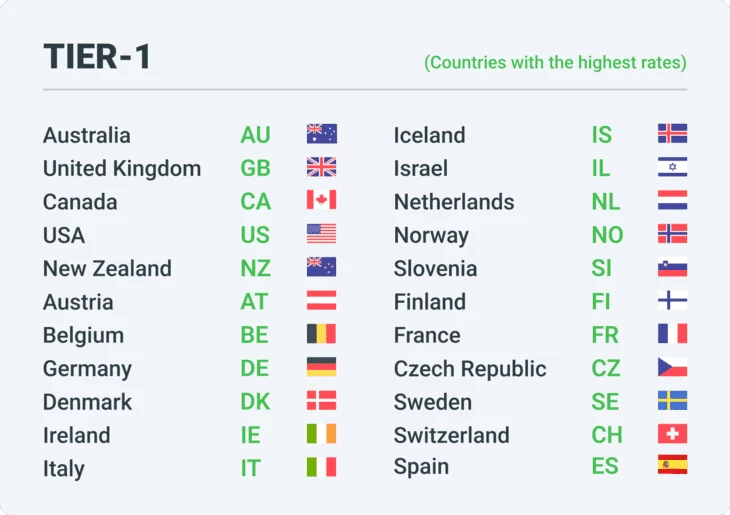
Tier 1 countries list
Countries that deliver high tier 1 traffic quality are:
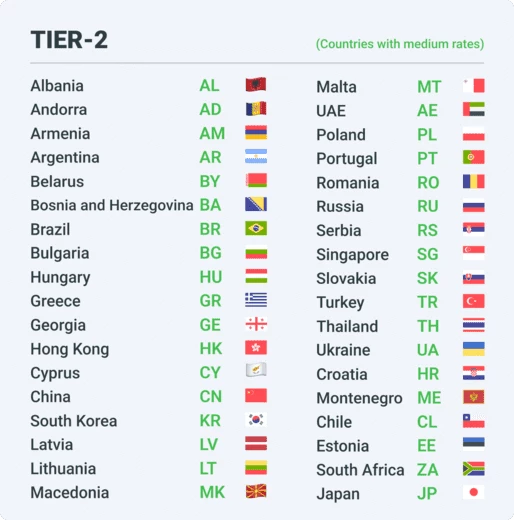
Tier 2 countries list
The tier 2 countries list consists of the following countries:
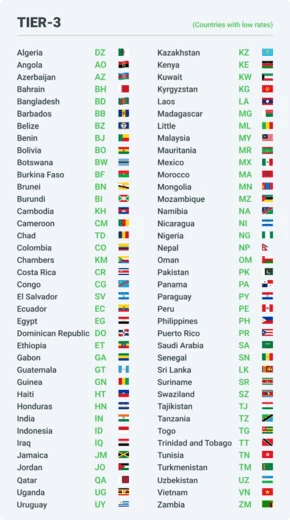
Tier 3 countries list
Tier 3 have their advantages. For example, advertisers targeting Tier 2 traffic reach emerging markets while keeping costs down.
Why Tier Lists Differ Between Networks and Platforms
Vanuatu was listed as a Tier 2 or Tier 3 country, which certainly raises questions, one of which could be: Is the classification fallible?
Yes and no. The problem is that even when we examine a list of tier 1 countries, we may find discrepancies because the lists differ from platform to platform, and there’s no universal standard that fits every network: each network creates its own lists based on what it values most. In other words, one advertiser might include Japan in its Tier 1 set, while another treats it as Tier 2.
Factors that affect tier classification
Some advertisers might include the country in their list of tier 2 countries because of the language, as it is one of the factors that can affect the campaign: as a rule, countries with widespread English proficiency are more desirable.
But there are other concerns as well:
Economic strength. Wealthier countries with higher GDP tend to be classified as Tier 1.
Digital adoption. Countries with widespread internet access and online payment usage rank higher.
Competition and ad costs. Stronger competition and higher CPC/CPM often push a market into a higher tier.
How to read tier charts properly (insight for beginners)
Tier 1 traffic sources, Tier 2 countries, Tier 3... Absolute gibberish if you haven’t worked a day with affiliate marketing. Luckily, there are a few tips:
Check which network created the chart: it’s the targeting data and priorities that shape the tiers.
Look for the explanation why the classification looks the way it looks: the countries may be grouped together based on internet usage, economic indicators, competition level, etc.
Tier 1 Traffic
Financially stable audiences, high consumer spending power, developed markets — these treasures are all found in tier 1 countries for ads. But are they so desirable?
Pros of Tier 1 traffic
What are tier 1 countries? Wealthy GEOs: their users have a higher disposable income, are familiar with online commerce, and more likely to engage. Besides, campaigns targeting Tier 1 tend to have predictable performance metrics and lower fraud risk.
Cons of Tier 1 traffic
Tier 1 countries advertising is still imperfect: it comes with higher costs and more competition. Campaigns in these GEOs require smarter creatives, optimized offers and approaches to justify the higher CPC or CPA.
Best verticals/offers for Tier 1 (2026)
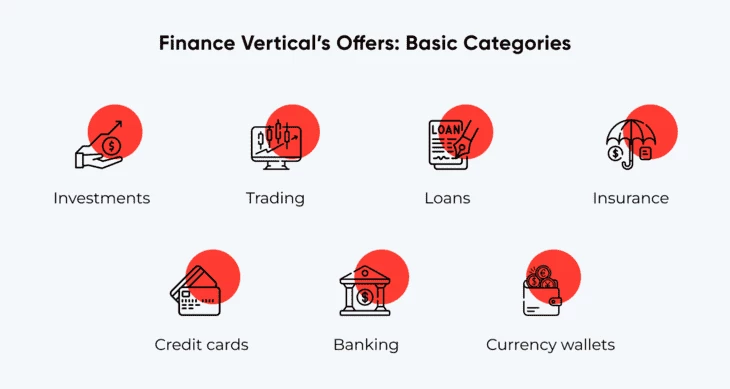
To monetize tier 1 traffic, you should understand the well-to-do audience. Typically, these users are most active in finance, ecommerce, gaming, health, or digital services (SaaS products, cybersecurity tools, and online services).
Tier 2 Traffic
Tier 2 countries in the world — Brazil or Mexico, for example — are also often targeted: campaigns have lower ad costs, but the audiences are still actively engaging with the ads.
Pros of Tier 2 traffic
You can achieve more if you combine tier 1 and tier 2 countries, but if this technique is too complicated, Tier 2 has quite a few advantages: lower costs, growing markets with emerging economies, and good testing ground for new offers and creatives.
Cons of Tier 2 traffic
Compared to Tier 1, Tier 2 still has lower purchasing power, so conversions may be smaller, and in certain cases, ads should be translated and localized to seem appealing to the audience.
Best verticals/offers for Tier 2 countries (2026)
The audiences, though not as sophisticated, still favor ecommerce, finance, gaming, health, and digital services.

Tier 3 Traffic
Tier 3 traffic comes from countries with less developed economies and lower consumer spending power, quite a cost-efficient segment. Although audiences in these GEOs may convert less frequently for high-priced offers, the low cost of acquisition and affordable traffic make it worth your time.
Pros of Tier 3 traffic
Tier 3 offers several advantages: clicks and impressions from these GEOs are among the cheapest you can buy; competition isn’t as high; advertising restrictions are not as severe, and online payment options are quickly spreading.
Cons of Tier 3 traffic
The drawbacks, however, are just as obvious: as the audiences have less disposable income, they barely convert on premium offers. Simultaneously, the payout values tend to be lower, and you actually have to put effort into localization to make your ad resonate with the users.
Best verticals/offers for Tier 3 countries (2026)
Overall, users in Tier 3 react to basic utility and entertainment apps, sweepstakes, mobile services, and VPN apps.
New Rapid-Growth Markets in 2026 (Tier 1 Alternatives)
Global economic patterns shift, digital adoption spreads further and further, so affiliates turn to the less obvious options.
Fast‑Growing Tier 2 Economies
Brazil, Mexico, Poland, Turkey, and Thailand may be put in the middle, but they nonetheless provide robust markets with expanding online penetration.
Countries Moving Closer to Tier 1
Some countries change the league, and China and India seem to be illustrative examples. They have massive populations, ever‑growing digital footprints, and surging e‑commerce adoption and digital payments, even in smaller cities and towns.
Regions with Rising Purchasing Power
“Economic changes? Yes, please”, said Eastern Europe, Southeast Asia, and Latin America. In 2026, the regions are improving the internet, raising incomes, and implementing digital services on a larger scale. Check out Malaysia, Indonesia, Czechia, and Romania.
Which Tier Should You Target? (Advice for Affiliates & Advertisers)
It all depends on your skills and expectations.
Best tier for beginners
Tier 2 is a safe bet: the countries in this group are normally growing markets with solid mobile usage and online shopping habits, but with lower ad competition compared to premium markets. If this still seems a trifle scary, you can experiment with Tier 3 GEOs.
Best Tier for Scaling Campaigns
If your campaign skills are solid, feel free to set sail for Tier 1, the most profitable avenue — just find the premium offer you want to promote, discover the winning creative, and enjoy the ride.
Best Tier for Low‑Budget Testing
Quick and affordable testing? Sounds like at least Tier 2, but we’d say Tier 3 is more desirable in this case. Tier 2 is all about moderate ad costs and solid conversion,while Tier 3 traffic gives access to huge volumes at a low cost.
Conclusion
There’s no universal classification that works for everyone — just as there’s no best tier that fits every affiliate. Beginners might want to start with Tier 2 or Tier 3; more experienced webmasters may be more eager to plunge into Tier 1, and those who expect a specific volume or provide specific offers aim for Tier 3. Just map out your expectations and preferences and choose the tier that fits best.
FAQ