Traffic Cardinal
wrote December 15, 2025
Traffic Cardinal
wrote December 15, 2025
Traffic Cardinal
wrote December 15, 2025
Traffic Cardinal
wrote December 15, 2025
Before we fully introduce the subject at hand, answer one question: Do you find push ads annoying?
As a professional, you might be a trifle elusive, eager to find a dozen excuses to not call things what they are. As an ordinary user, you will express yourself in a more straightforward way: yes, they can be a real bother, interrupting whatever you are doing and breaking the connection between you and the content you are consuming.
But what if we told you that in-page push ads are a treasure trove you have been looking for? Find all the details below.
What Are In-Page Push Ads?
Most affiliates claim to understand the crux of push notifications: not everyone is willing to ask the question “what is inpage push?” out loud. Fear not, if you’re one of those unfortunate who haven’t had the time to learn the basics, we’re eager to share.
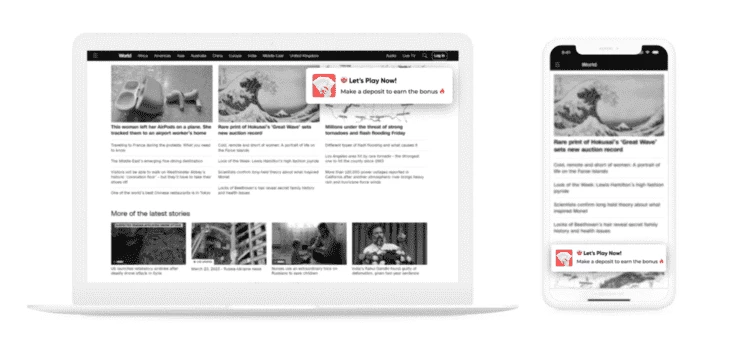
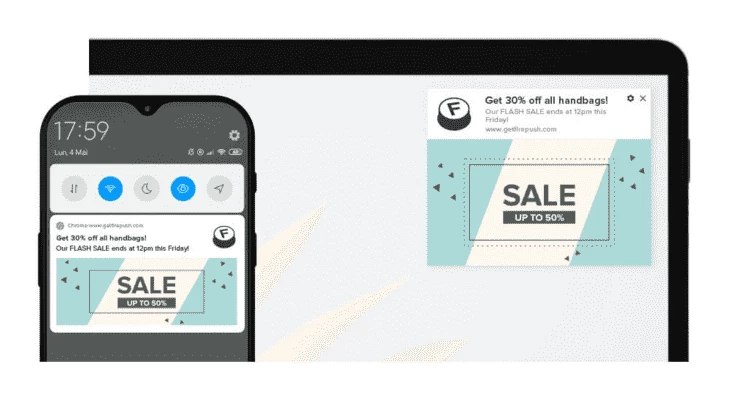
In-page push ads are display ads that are designed to look and behave like native push notifications, appearing on publishers’ sites. What sets them apart, however, is their secret feature: users do not subscribe to newsletters to see these notifs.
How In-Page Push Ads Work
Before we go into detail, we’d like to outline the working principle, which is quite easy to grasp.
When users visit publishers’ sites, they come across in-page push widgets. Such widgets, as a rule, resemble small notification-like units. What happens next? People click the icon and get redirected to the advertiser’s landing page — as planned. Voilà, you’ve achieved your goal... or are about to achieve it.
In-Page Push vs Web Push: Key Differences
In some ways, inpage push ads may remind you of their counterpart — web push notifs, and if you spot the similarities, you’re not incorrect: they both mimic notifications. But they are not the same.
Subscription (not) required. Web push requires subscription or at least permission before notifications can be sent, while in-page push shines for everyone in the room — for any visitor on the publisher’s website.
Display features. In-page push, that is. Web push is tailored for another strategy: they are sent via the user’s browser or device notification centre, not through the webpage — it’s possible to get the notifs even when the browser is closed. In other words, you need to grant permission to receive web push, but you don’t have to tinker with settings to enjoy in-page push banners.
Devices and browsers galore. In-page push is web-based, so it easily bypasses all sorts of limitations. Web push is not so sophisticated: even remotely tech-savvy users can avoid its influence.
Advantages of In-Page Push Ads
Now, let us be more clear.
No Subscription Required
We have highlighted it several times already, but we haven’t stressed it enough: remember, users do not need to actively grant permission to see the ad, which makes it one of the most appealing advertising options on the internet.
Bypasses Browser Restrictions
Remember the infamous Chrome update that ruined campaigns in the blink of an eye, affecting all formats across the internet? Yeah, we’re talking Chrome 80, which introduced the SameSite cookie policy and the Heavy Ad Intervention — you must recall that fateful day in 2020. While many display campaigns were affected, inpage push traffic continued to thrive, totally unperturbed by the situation.
Wider Reach and More Traffic Types
Web push, though better equipped for modern advertising standards, still gambles away its chances when it comes to iOS users. In-page push is available on any device at any time of day, reaching bigger audiences across all platforms.
Higher Click-Through Rates Compared to Web Push
In-page push is visible when users are actively browsing sites, so it tends to generate higher CTR than good ol’ web push.
Reduced Banner Blindness
Nowadays, affiliates are up in arms over banner blindness: they rack their brains trying to invent a weapon against it. Seems like the weapon was always within an arm’s length: as in-page push act like device notifications, users have not yet built up a tolerance to it.
Flexible Payment Options: Pay-Per-Click or Conversions
CPM is good, but not always convenient. It would be great to switch to something more lucrative, say, CPC, right? In-page push isn’t limited to subscriptions, so advertisers can pay for actual clicks only. Sounds fair, no?
Disadvantages of In-Page Push Ads
Alas, even the best features have their flaws.
Lower Traffic Volume
Inpage push is still relatively new; that’s why it’ll take some time to achieve the expected readouts usually seen in other ad formats.
Multiple Ads on One Page Can Be Distracting
Banner blindness forgotten, user experience saved, we’ve emphasized that enough. However, tons of in-push ads emerging on the same page turn into a distracting abundance. Either way, consult your manager about the limits your ad network has.
Limited GEO Availability
Alas, not all countries have the same volume of traffic, which means that in certain regions, your in-page push endeavors may be restricted or less effective.
Best Geos and Niches for In-Page Push Ads
Are you contemplating your in-page push campaigns? Without further ado, let’s get to it!
Top Performing GEOs for iOS and Android
As we have mentioned in the previous paragraph, in-page push isn’t yet common — compared to its more traditional counterparts, so certain GEOs might not be able to boast rich inventory. However, we are ready to announce the roster of top-performing regions for both iOS and Android:
France
Germany
Japan
China
USA
Serbia
Thailand
Indonesia
Vietnam
Malaysia
India
Best Vertical Niches
GEOs make no sense if you don’t know which offers would work best. Luckily, we’ve just contrived a list of niches for you to try:
Finance
Sweepstakes
LeadGen
Dating
Nutra
Sports betting
Ecom
GEO-Vertical Bundles for Maximum ROI
While the spray and pray strategy may indeed work in certain GEOs with certain verticals, it will almost definitely underperform with in-page push offers. Our readers do not take chances, so we want to briefly cover a few GEO + vertical bundles for you to test.
If you are planning to launch a betting campaign, go for Thailand, Indonesia, Serbia, Vietnam, or Malaysia.
Affiliates operating within the dating niche might tap into the markets in France, China, India, Germany, Japan, or the USA.
E-commerce specialists will be highly successful in Europe and the USA, though certain parts of Asia may also bring profit, but the final result depends on the offer and traffic source.
Top Traffic Sources for In-Page Push Ads
Speaking of traffic sources we have briefly tackled above… Here are quite a few that deserve your utmost attention.
Adsterra
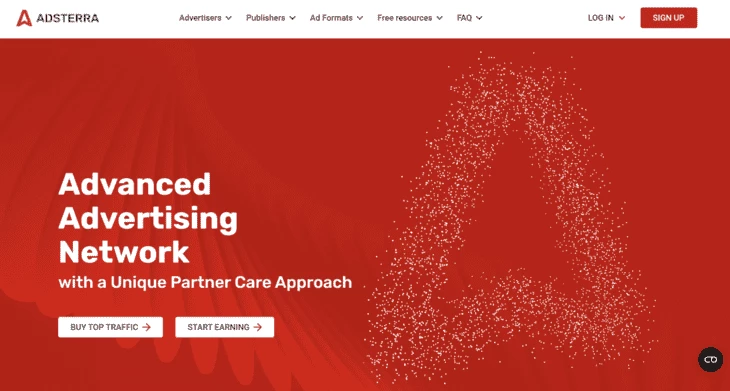
Everything you know about Adsterra is probably true: it is a world-famous ad network and a veteran in affiliate marketing and digital advertising, respectively. According to their official site, the network delivers genuine CPA/CPM/CPC traffic of over 2.3B impressions on a weekly basis and boasts “unprecedented user engagement. Apart from the usual features you might expect, the platform offers 3-level security, diverse targeting settings, smart bidding, advanced tracking, and partner care with professional support.
Advantages for Advertisers and Publishers
Both advertisers and publishers can benefit from Adsterra, and it’s not only about the three-layer security. Advertisers working with the platform will get access to multiple creative templates with proven CTRs; CPA, CPM, and CPA pricing options; and Social Bar Ads, which combine the best features of display and push ads. Publishers, in turn, will certainly receive paid traffic (browers do not block these ads); 100% fill rate; higher ad view rates and higher CPM caused by increased CTRs.
TrafficStars
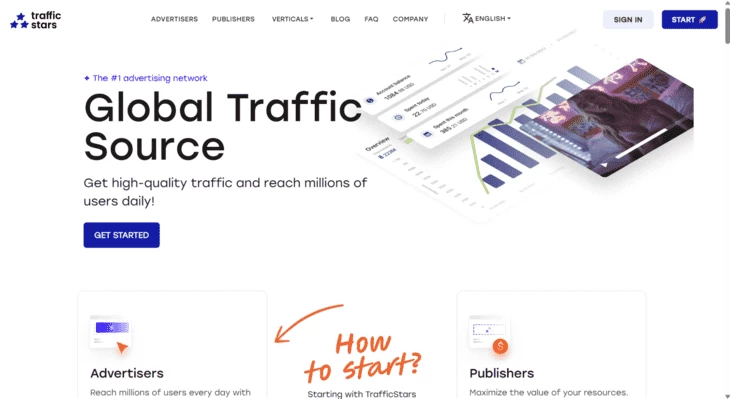
TrafficStars supports a plethora of formats, so in-page push is just another enticing option for you to try. Keep in mind that this platform focuses on designs and formats for Dating, iGaming, and several others; at the same time, the platform is enabled with smart targeting settings and automated optimization engines, which significantly simplify all processes and boost your conversions.
PropellerAds
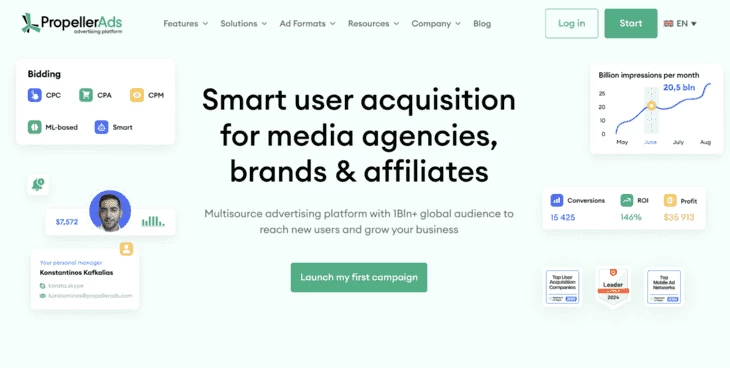
PropellerAds keeps up the pace with the industry’s development: the platform added in-page push to its library of ad formats and has been successfully working with it ever since. Many affiliates claim that PropellerAds is a perfect starting point for less experienced professionals (which, nevertheless, does not exclude top-notch experts) as it has wide targeting options (by device, GEO, browser, connection, OS, etc.) and is known for its reliable reach.
Adcash
There’s nothing easier than picking the in-page push option on Adcash. In fact, it’s a matter of two clicks: select the ad format and switch to further settings, be it creative or targeting (which is, by the by, quite impressive: SSPs, device, GEOs, website categories, and many more to focus on). What’s more peculiar, Adcash allows its partners to choose between its own traffic or partner traffic.
EvaDav
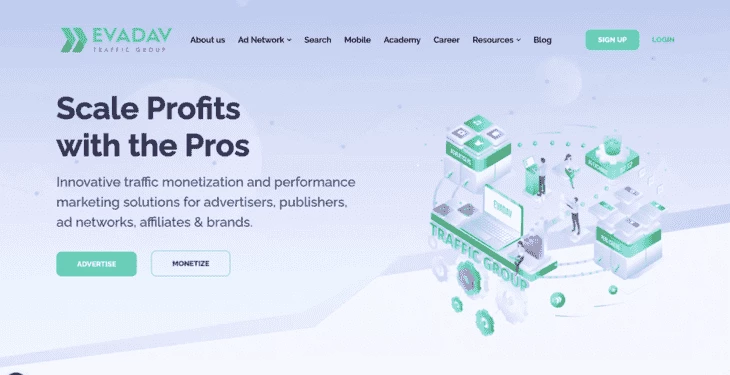
Global reach, high impression rates taken directly from high-converting sources — sounds like a dream, which it isn’t. It is simply EvaDav, the platform with major representation in India, Russia, and the USA. We can go on and on describing its key features, but here’s one truly indispensable: the ad-tech keeps improving its predictive audience-behavior algorithms to make sure that your ads reach the right audience at the right time.
Other Notable Networks
Of course, the entire market of ad networks working with in-page push cannot be limited to the five options we’ve mentioned in our roster. Quite possibly, you checked out the options we’ve provided above and weren’t satisfied with the results. If that’s the case, explore other platforms — they may have more flexible monetization models, specific niches or GEOs, additional ad formats, or lower entry thresholds. For example, you can conduct your own research on RichAds, Push.House, Zeropark, Kadam, HilltopAds, or MGID.
Tips for Launching Your First In-Page Push Campaign
There’s no universal recipe for success, but in this section, we will try to give you some tips.
Target the Latest OS Versions
The world is developing, so are OS versions: they get newer, acquire new features, and get rid of outdated relics we no longer use. The rule of thumb is to target users on the latest versions of major operating systems, as they tend to have newer browser versions (obviously) and better compatibility with modern ad formats. These are not mere words: by doing that, you will avoid performance issues.
Test Creatives and Images Before Launch
How obvious is that? As a rule, affiliates have several variants of every image and every creative, so it won’t hurt to test them all — perhaps a few times, just to be sure. You want to see what your audience responds to, what pictures and texts people are most susceptible to, and what creatives they are drawn to, so try several options and analyze the results.
Configure Postback Tracking
Postback tracking is a must, even if you think you could do without it. It’s impossible to overestimate the importance of the tool: it identifies which sources, creatives, and devices deliver real conversions; helps you make up your mind on optimization patterns, and increase bids on well-performing sources.
Use Emojis Strategically
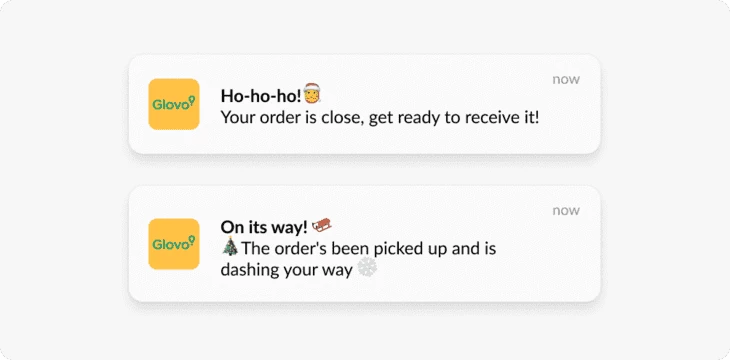
Oh, yeah, the smiley face. Or the crying face. Or not a face at all — just a thumbs-up. Depending on the offer, you can place strategic helpers — emojis — in strategically important places where they enhance verisimilitude with native notifications. Don’t overdo it with fifteen emojis in one message; just use one or two to draw attention and elicit a reaction from the user.
Start with Broad Campaigns
Common knowledge #1: run your first campaign with broad targeting and minimal restrictions to gather enough data on the target audience (say, set multiple GEOs, all devices, and use several creatives). If you narrow down immediately, you risk getting fewer impressions than anticipated; besides, in this case, you won’t have enough space for future optimization.
Conclusion: Maximizing ROI with In-Page Push Ads
Once you nail in-page push, you won’t be stopped: this versatile and effective format can bypass even the most intricate algorithms and the vilest updates, as it transpired when Chrome unveiled its notorious SameSite cookie policy and the Heavy Ad Intervention strategy. Besides, in-page push ads deliver high engagement, provide wide device coverage, and a broad reach without additional subscriptions or efforts on the part of the user, publisher, or advertiser.
FAQ